Sponsored

BM3 Custom Tuning help

QTR FMS

Well-Known Member
First Name
Fahad
Joined
Nov 4, 2025
Threads
4
Messages
71
Reaction score
32
Location
Qatar
Car(s)
2024 6MT
I’ll double check these
I also did get my car back, uploaded my updated tune without the psi limit and I hit the limp mode in 3rd. Limit it to 26psi again and I logged my car twice without the limp.
https://datazap.me/u/lesoupra/logs/cmqls01yr0009k006iv4py890
https://datazap.me/u/lesoupra/logs/cmqls00lq0007k006meski80j

From the log, it seems you are hitting the end of injection limiter (RF Max 8) and the cylinder fill Limiter (131072).

You need to lower the values at the end of injection. You can make it 70 above 100 load.

And for the 131072 its basically a cylinder fill. It usually cause by overboosting or exceeding load, raise your load limiter and try to keep it 10% higher than your actual.

try the above changes then, make another log and it would be better to make longer full throttle log, in third from 2000rpm to 7000rpm if you dont have wheelspin issues. or otherwise 4000rpm to 7000rpm.

Edit: are you using OEM boost control or BM3 custom boost control feature.
Sponsored

 
Last edited:
OP
OP
le.soupra

le.soupra

Member
Joined
Jun 28, 2025
Threads
2
Messages
15
Reaction score
1
Location
US
Car(s)
Launch Edition Supra
From the log, it seems you are hitting the end of injection limiter (RF Max 8) and the cylinder fill Limiter (131072).

You need to lower the values at the end of injection. You can make it 70 above 100 load.

And for the 131072 its basically a cylinder fill. It usually cause by overboosting or exceeding load, raise your load limiter and try to keep it 10% higher than your actual.

try the above changes then, make another log and it would be better to make longer full throttle log, in third from 2000rpm to 7000rpm if you dont have wheelspin issues. or otherwise 4000rpm to 7000rpm.

Edit: are you using OEM boost control or BM3 custom boost control feature.
https://datazap.me/u/lesoupra/logs/cmque7oz60003jm06gynzvqqf
Hopefully this is a better log
 

QTR FMS

Well-Known Member
First Name
Fahad
Joined
Nov 4, 2025
Threads
4
Messages
71
Reaction score
32
Location
Qatar
Car(s)
2024 6MT
You still have 131072 code, which is closing the throttle down to 41%.

What are your Maximum Relative Filling Characteristic table values? and check if you are limited by other load limiter tables.

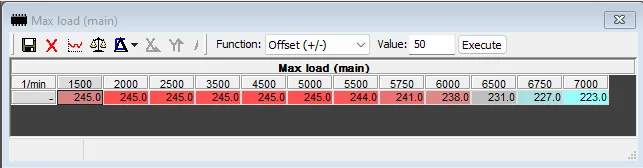
You might want to look at all load limiters, which I believe are 10 tables (some are already maxed out at 327%), and add 50 over stock values to get to 245% load. This should get you to 26psi more or less, and you can then fine tune it later based on your boost curve.

1782471213885-fe.webp


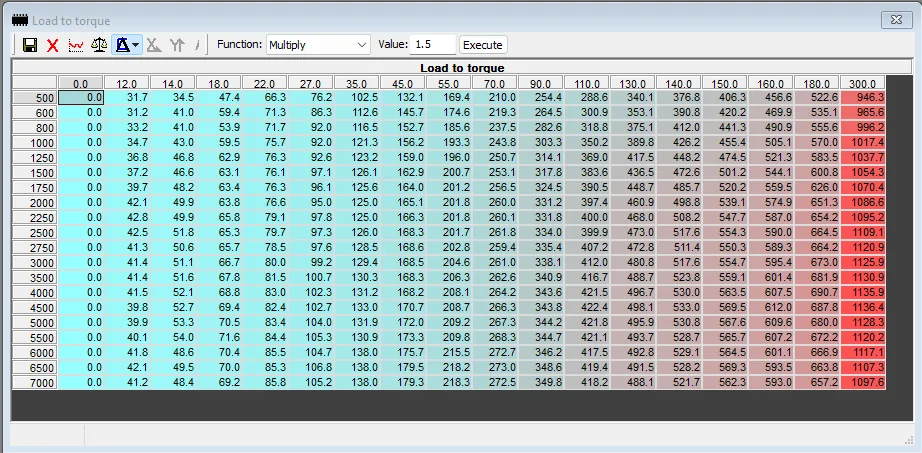
For load to torque, I only changed the last column from 200 to 300 and multiplied the values by 50%, this will make it easier to track limiters later.

1782470489106-tl.webp


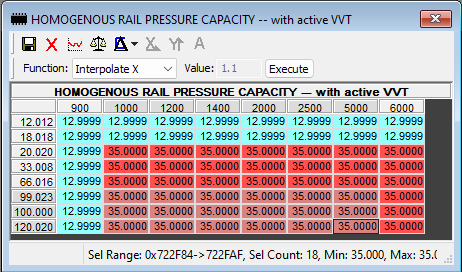
You are also crashing your hpfp at 5000rpm and probably in the lower rpm, there are 4 rail pressure tables that look similar to the one below. Change the highlighted cells to 30MPA and then you can continue to fine tune the rail pressure as you continue to raise boost and adjust afr.

1782468931018-op.png


Your boost target is 25-23 psi, but the actual boost is 16 psi because your throttle is closing. This needs to be fixed before we try to raise the target further.
 
OP
OP
le.soupra

le.soupra

Member
Joined
Jun 28, 2025
Threads
2
Messages
15
Reaction score
1
Location
US
Car(s)
Launch Edition Supra
You still have 131072 code, which is closing the throttle down to 41%.

What are your Maximum Relative Filling Characteristic table values? and check if you are limited by other load limiter tables.

You might want to look at all load limiters, which I believe are 10 tables (some are already maxed out at 327%), and add 50 over stock values to get to 245% load. This should get you to 26psi more or less, and you can then fine tune it later based on your boost curve.

1782471213885-fe.webp


For load to torque, I only changed the last column from 200 to 300 and multiplied the values by 50%, this will make it easier to track limiters later.

1782470489106-tl.webp


You are also crashing your hpfp at 5000rpm and probably in the lower rpm, there are 4 rail pressure tables that look similar to the one below. Change the highlighted cells to 30MPA and then you can continue to fine tune the rail pressure as you continue to raise boost and adjust afr.

1782468931018-op.png


Your boost target is 25-23 psi, but the actual boost is 16 psi because your throttle is closing. This needs to be fixed before we try to raise the target further.
I noticed the limp mode usually happens 1-2nd gear after shifting during a pull. I even lowered boost by 150hpa and lowered p-gain and high end on the compressor map for flex fuel. I didn't have this issue before when I first worked on this tune. It seemed to be happening when I started messing with the torque tables.
I made those changes to all the torque tables you mentioned and read through the bootmod3 guides. Raised all the limiters to 1000nm and disabled all the torque flags/intervention. Is there one i shouldnt have disabled?
I also did a pull a couple days ago with the bm3 launch control in 3rd and the limp didnt happen, so it seems to be happening mainly 1-2nd gear. In 1st im running 30% torque reduction and 20% in 2nd as well.
 

QTR FMS

Well-Known Member
First Name
Fahad
Joined
Nov 4, 2025
Threads
4
Messages
71
Reaction score
32
Location
Qatar
Car(s)
2024 6MT
I noticed the limp mode usually happens 1-2nd gear after shifting during a pull. I even lowered boost by 150hpa and lowered p-gain and high end on the compressor map for flex fuel. I didn't have this issue before when I first worked on this tune. It seemed to be happening when I started messing with the torque tables.
I made those changes to all the torque tables you mentioned and read through the bootmod3 guides. Raised all the limiters to 1000nm and disabled all the torque flags/intervention. Is there one i shouldnt have disabled?
I also did a pull a couple days ago with the bm3 launch control in 3rd and the limp didnt happen, so it seems to be happening mainly 1-2nd gear. In 1st im running 30% torque reduction and 20% in 2nd as well.
its difficult to say without looking at a log with the issue clearly happening.

from the previous log it seems there are too many issues that needs to be solved before we can pin point the issue.

some of those issues could be causing limp mode in 1-2 gear but the only difference it might be worse in 1-2 due to lighter load.

you could be hitting hpfp or end of injection limiter for example.

unfortunately, with bootmod3 i cant look at your tune to recommend changes that might help. So i can only comment on the log.
 
OP
OP
le.soupra

le.soupra

Member
Joined
Jun 28, 2025
Threads
2
Messages
15
Reaction score
1
Location
US
Car(s)
Launch Edition Supra
its difficult to say without looking at a log with the issue clearly happening.

from the previous log it seems there are too many issues that needs to be solved before we can pin point the issue.

some of those issues could be causing limp mode in 1-2 gear but the only difference it might be worse in 1-2 due to lighter load.

you could be hitting hpfp or end of injection limiter for example.

unfortunately, with bootmod3 i cant look at your tune to recommend changes that might help. So i can only comment on the log.
i think i figured it out
my dumbass forgot to raise the exceeded acceleration table
 

ColonelAdama

Well-Known Member
First Name
Adam
Joined
Jan 30, 2023
Threads
2
Messages
1,457
Reaction score
1,668
Location
Greenville, SC
Car(s)
2023 Absolute Zero Supra 3.0 Premium MT, 2015 GTI
Don't just increase the last column in the load to torque table. Great way to get transmission slip if you are making any power.
Whats your guidance on the scaling of the load to torque table when upgrading a turbo? Obviously hard to know exactly what torque the car makes at MBT even with a dyno, since we don't run at MBT.

Even on stock turbo, dyno results are ~100nm > than what the log shows when only the last column is increased.
 

razorlab

Well-Known Member
First Name
Bryan
Joined
Oct 2, 2021
Threads
29
Messages
8,578
Reaction score
16,836
Location
Not this fucking shit fuck stupid forum.
Car(s)
Not a Corvette.
Whats your guidance on the scaling of the load to torque table when upgrading a turbo? Obviously hard to know exactly what torque the car makes at MBT even with a dyno, since we don't run at MBT.

Even on stock turbo, dyno results are ~100nm > than what the log shows when only the last column is increased.
The load to torque table Z values are inner indicated torque, in Nm.

Inner torque is the gross torque produced by combustion inside the cylinders: the torque the expanding gas exerts on the pistons, before any mechanical or pumping losses are subtracted. It's a pure thermodynamic/combustion quantity.

This is different than crankshaft torque. The difference between crankshaft torque and inner torque are the losses. Kind of like the loss differences between crankshaft torque and wheel torque. The DME subtracts from the inner indicated torque values, losses from friction, pumping, aux/accessory loads, and drag = crankshaft torque. So inner torque will always be higher than crankshaft torque.

It gets even more complicated as there is also a step within inner torque: the optimal inner torque (at best/reference spark, MBT) versus the actual inner torque after spark and lambda efficiency.

The torque to load table (KF_MDIOP_1_TQE) values matter a lot in the system because it's basically the modeling for all air flow. They are the best-spark inner torque the given air charge would produce. The DME then multiplies this by ignition and lambda efficiency to get actual inner torque, and subtracts friction/pumping/accessory losses to arrive at the crank torque. It's the air-charge-torque model:

  • Forward, it turns your measured fill + rpm into the reference inner torque used everywhere downstream (reporting, limiter comparisons, reserve calculation).
  • Inverted, it turns a required inner torque back into the fill target the boost/throttle controllers chase. Every torque request becomes a fill target through this map. Boost controllers less so when using MHD+.

All that is why it's important to scale with added power. The TCU uses reported values to help determine clamp pressure, along with a ton of other models.

I'm not actually sure which torque channel MHD has for it's torque logging. I'm going to assume it's either requested torque or crankshaft torque. There are a few different torque channels that the DME reports out:

  • Inner (indicated) torque — combustion torque before losses.
  • Crankshaft (effective) torque — the real output torque after friction/pumping/accessory losses.
  • Wheel torque — crank torque multiplied through the gearbox and final drive, minus driveline losses.
 

ColonelAdama

Well-Known Member
First Name
Adam
Joined
Jan 30, 2023
Threads
2
Messages
1,457
Reaction score
1,668
Location
Greenville, SC
Car(s)
2023 Absolute Zero Supra 3.0 Premium MT, 2015 GTI
The load to torque table Z values are inner indicated torque, in Nm.

Inner torque is the gross torque produced by combustion inside the cylinders: the torque the expanding gas exerts on the pistons, before any mechanical or pumping losses are subtracted. It's a pure thermodynamic/combustion quantity.

This is different than crankshaft torque. The difference between crankshaft torque and inner torque are the losses. Kind of like the loss differences between crankshaft torque and wheel torque. The DME subtracts from the inner indicated torque values, losses from friction, pumping, aux/accessory loads, and drag = crankshaft torque. So inner torque will always be higher than crankshaft torque.

It gets even more complicated as there is also a step within inner torque: the optimal inner torque (at best/reference spark, MBT) versus the actual inner torque after spark and lambda efficiency.

The torque to load table (KF_MDIOP_1_TQE) values matter a lot in the system because it's basically the modeling for all air flow. They are the best-spark inner torque the given air charge would produce. The DME then multiplies this by ignition and lambda efficiency to get actual inner torque, and subtracts friction/pumping/accessory losses to arrive at the crank torque. It's the air-charge-torque model:

  • Forward, it turns your measured fill + rpm into the reference inner torque used everywhere downstream (reporting, limiter comparisons, reserve calculation).
  • Inverted, it turns a required inner torque back into the fill target the boost/throttle controllers chase. Every torque request becomes a fill target through this map. Boost controllers less so when using MHD+.

All that is why it's important to scale with added power. The TCU uses reported values to help determine clamp pressure, along with a ton of other models.

I'm not actually sure which torque channel MHD has for it's torque logging. I'm going to assume it's either requested torque or crankshaft torque. There are a few different torque channels that the DME reports out:

  • Inner (indicated) torque — combustion torque before losses.
  • Crankshaft (effective) torque — the real output torque after friction/pumping/accessory losses.
  • Wheel torque — crank torque multiplied through the gearbox and final drive, minus driveline losses.
Thanks for the explanation. Yeah I have only ever scaled up the final column, I thought you had written that in the self tune thread, but its definitely underrating the tq.

Do you recommend scaling the entire z axis evenly, staying relatively linear?

I know the car probably has no idea what CFM is actually coming in, and fudge it with the fuel scalar to keep trims in check. Most other tuner logs I ever see are definitely not scaled right either.
 

QTR FMS

Well-Known Member
First Name
Fahad
Joined
Nov 4, 2025
Threads
4
Messages
71
Reaction score
32
Location
Qatar
Car(s)
2024 6MT
Don't just increase the last column in the load to torque table. Great way to get transmission slip if you are making any power.
Extending the last column proportionally should increase line pressure while making more power so i doubt it would cause a slip, scaling up the whole table should be on dyno, assuming the car is actually making more power below 180% load.

i assume with pure800 you should only push the torque curve upward into higher rpm to match the dyno graph rather than scaling the table by x%.

I haven't tuned AT supra so I haven't seen the TCU tables, but i assume torque would have an effect up to specific torque, then the TCU torque axis would probably need to be extended as well, so a proper calibration to the TCU should be required to keep the transmission happy.

personnally i prefer to tune the transmission separately from the engine torque request and by driver feel (running as high as possible line pressure without affecting drivability, basically firm but smooth shifts)
 

razorlab

Well-Known Member
First Name
Bryan
Joined
Oct 2, 2021
Threads
29
Messages
8,578
Reaction score
16,836
Location
Not this fucking shit fuck stupid forum.
Car(s)
Not a Corvette.
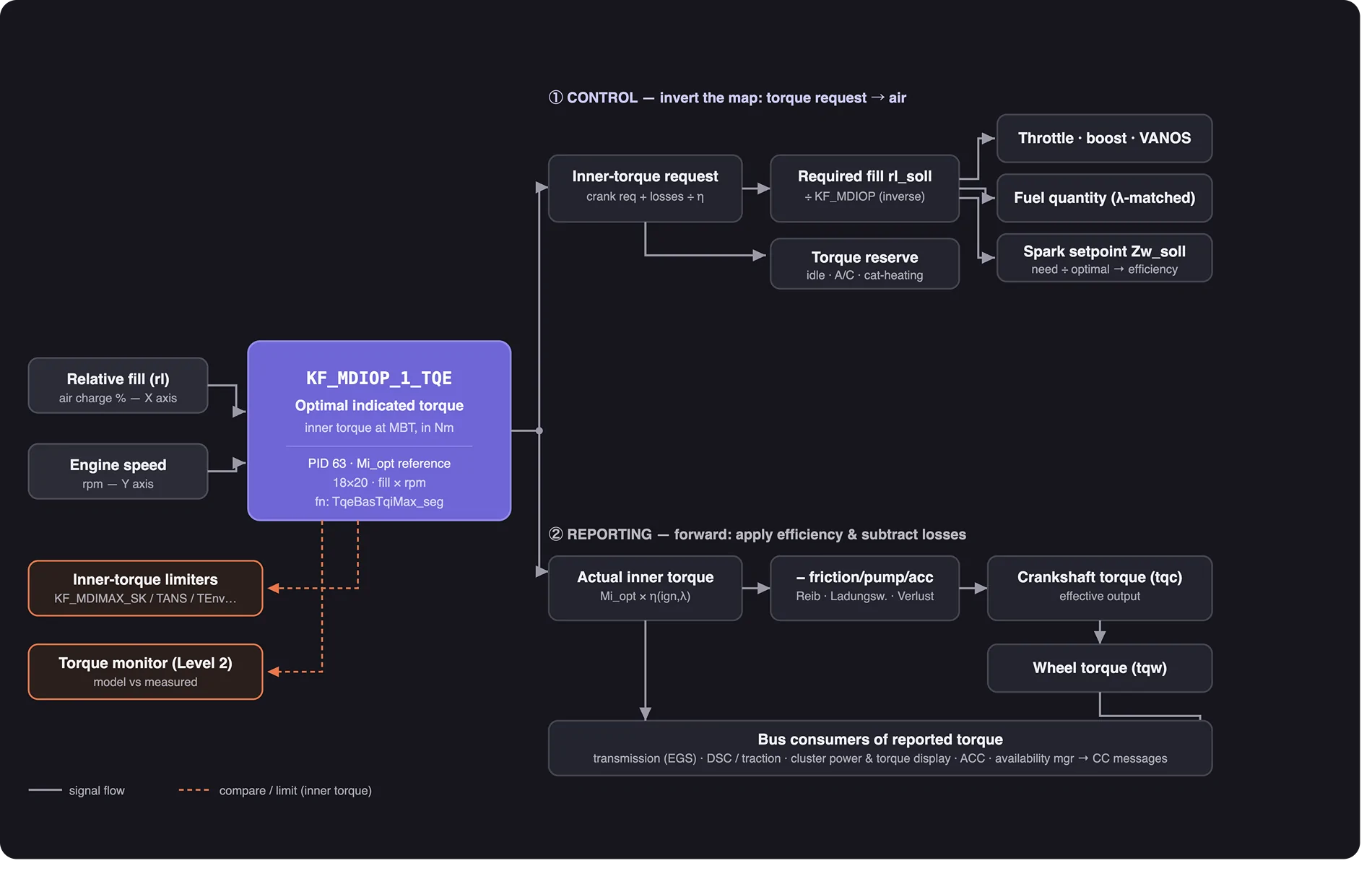
Here is a visual diagram, created from the official BMW SwCalDocs, that shows what KF_MDIOP_1_TQE influences. Clearly showing that the TCU is a consumer.

kf_mdiop_1_tqe_influence_map_dark.webp


OBD PID for the reference torque coming out of KF_MDIOP_1_TQE: PID 63 (Nm)

Other noteworthy PID's:

61 — driver's demand engine torque (%)
62 — actual engine torque (%)
63 — engine reference torque (Nm) referenced above
64 — engine percent torque data (idle + points)

The PID's that report in % (61 and 62) are a percentage of the Nm reported from PID 63

So 61-64 are all reference torque.

Just remember that normal OBD PID's are slow-as-molasses.
 
Last edited:

QTR FMS

Well-Known Member
First Name
Fahad
Joined
Nov 4, 2025
Threads
4
Messages
71
Reaction score
32
Location
Qatar
Car(s)
2024 6MT
Okay.

If you want to continue to argue with actual official bmw documentation and actual experience from tuning hundreds of AT BMWs, have at it. I just won’t.
Not arguing, im saying torque should be scaled proportional with power increase and dyno mapping.

I understand how a torque based ecu work this is not limited to bmw even gm uses the same concept.
Sponsored


Top