Sponsored

Harness install question

Vtec13

Active Member
First Name
Mike
Joined
Apr 6, 2024
Threads
2
Messages
36
Reaction score
37
Location
Sedalia, CO
Car(s)
2021 Supra, 2011 M3, 2002 S2000 Turbo,
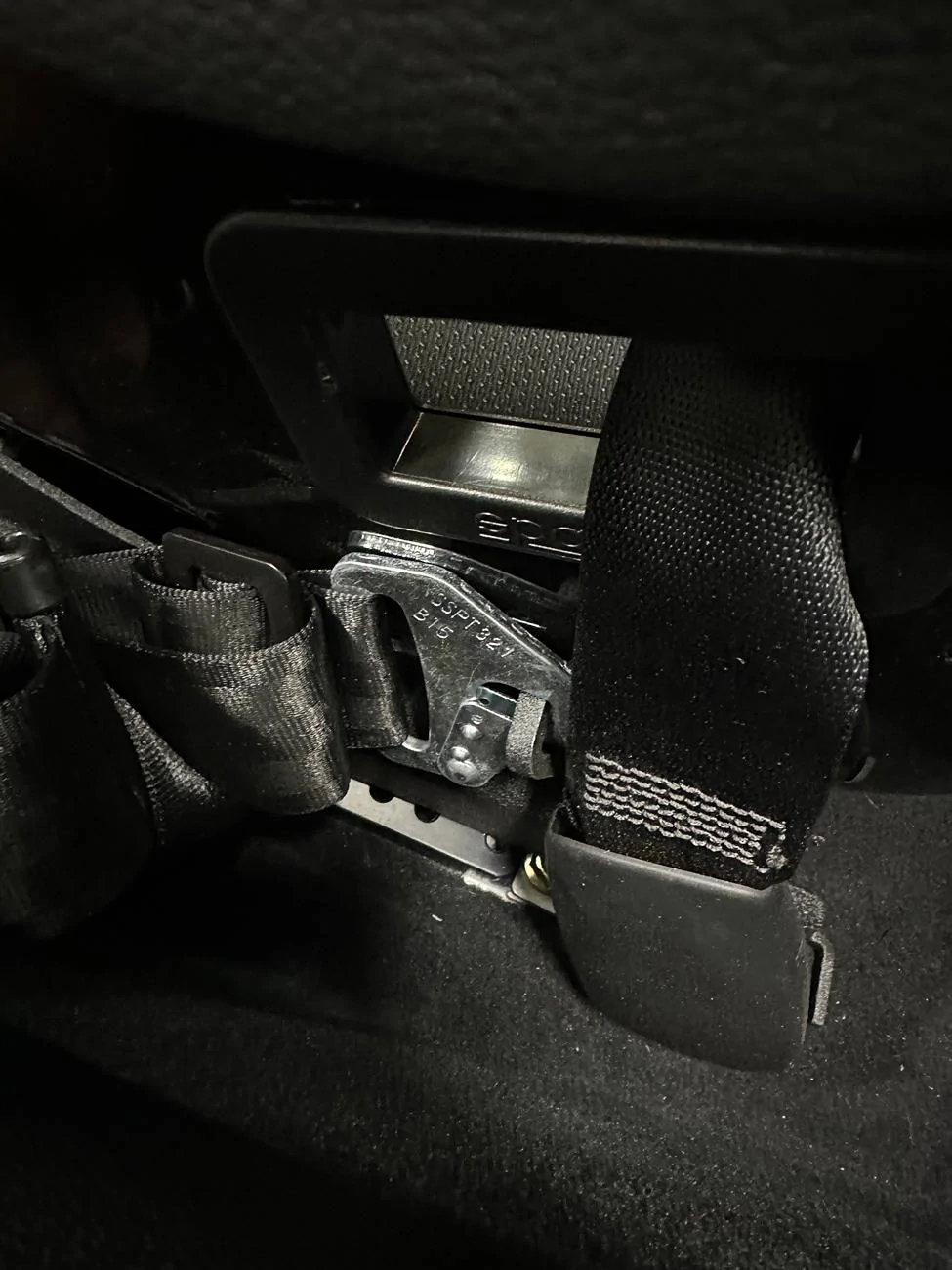
everyone always talks about how to mount the shoulder straps when it comes to harnesses, but that is the easy part. show me where you mount the lap and sup straps. are people drilling through the chassis and putting backing plates? or some sort of bracket.
show me what you have done
Sponsored
 

razorlab

Well-Known Member
First Name
Bryan
Joined
Oct 2, 2021
Threads
29
Messages
8,568
Reaction score
16,797
Location
Hudson Valley, NY
Car(s)
Not a Corvette.
Side mounts with bolt on brackets or built in.

I run the Brey-Krause side mounts and they have mounts built in that I clip to.

IMG_2828.webp
IMG_4527.webp
 

Gabe

Well-Known Member
First Name
Gabriel
Joined
Feb 19, 2024
Threads
39
Messages
674
Reaction score
1,234
Location
Miami
Car(s)
2024 Supra MkV/Tesla Model S/Tesla Model X
Most harness manufacturers advise against seat mount and recommend chasis mount with backing plate. I just got my set of harnesses and im awaiting the RSR roll bar and a set of Sparco seats. I am planning to install the OEM seatbelt to the seat, but the harness’ lap and anti Sub belts to the chasis with backing plates and use a Hans.

Also, mounting the shoulder belt to the transverse bar in the car is at best useless, if not straight dangerous because that bar is bolted with really flimsy bolts and material and is not intended to be part of the structure of the car, is just a decorative fixture. (Even if is replaced by the Cusco bar). Do not compromise in safety. The OEM seatbelt is a much better restrain device than any non spec installed harness mount.

When I do mine - in the next 2 weeks - I will document the process.
 
OP
OP
Vtec13

Vtec13

Active Member
First Name
Mike
Joined
Apr 6, 2024
Threads
2
Messages
36
Reaction score
37
Location
Sedalia, CO
Car(s)
2021 Supra, 2011 M3, 2002 S2000 Turbo,
i agree, on all my other cars i have built i have drilled the chassis and put backing plates. that way you are strapped to the car and not to the seat, in case the seat or seat mounts fail.

I am very aware of the "harness bar" in the car not being structural, i figured that was a a given and why i wanted to focus on the lap/sub belts.

this is a new platform to me so i am trying to gather all the info i can about what people are doing.
 

Rensuhlo

Well-Known Member
First Name
Chuck
Joined
Nov 12, 2022
Threads
19
Messages
1,667
Reaction score
3,272
Location
Georgia
Car(s)
NA
Most harness manufacturers advise against seat mount and recommend chasis mount with backing plate. I just got my set of harnesses and im awaiting the RSR roll bar and a set of Sparco seats. I am planning to install the OEM seatbelt to the seat, but the harness’ lap and anti Sub belts to the chasis with backing plates and use a Hans.

Also, mounting the shoulder belt to the transverse bar in the car is at best useless, if not straight dangerous because that bar is bolted with really flimsy bolts and material and is not intended to be part of the structure of the car, is just a decorative fixture. (Even if is replaced by the Cusco bar). Do not compromise in safety. The OEM seatbelt is a much better restrain device than any non spec installed harness mount.

When I do mine - in the next 2 weeks - I will document the process.
ok, Gabe.
But just so you know…I can’t read
 

razorlab

Well-Known Member
First Name
Bryan
Joined
Oct 2, 2021
Threads
29
Messages
8,568
Reaction score
16,797
Location
Hudson Valley, NY
Car(s)
Not a Corvette.
Everyone has an opinion on these things. I've seen people with chassis mounted harness running without a Hans, or attach their harness to an RSR rollbar attached by one rivnut and one bolt in the back while crying about the cusco bar (which somebody in this thread just did), and other stupid shit. Personal responsibility is very subjective.

I'll take my my harness attached to my side mounts which are hard mounted to the chassis with eight bolts (nothing is attached to the actual seat, which I agree is dumb AF) vs a harness attached to the chassis with one bolt but I've also been known to drink one too many beers on occasion as well so what the hell do I know.

BTW, OEM seat restraints are also mainly attached to the seat mounts and not the chassis so saying they are safer than a six point harness attached to hard mounted seat mounts and not the chassis is some serious cognitive dissonance.
 
Last edited:

Gabe

Well-Known Member
First Name
Gabriel
Joined
Feb 19, 2024
Threads
39
Messages
674
Reaction score
1,234
Location
Miami
Car(s)
2024 Supra MkV/Tesla Model S/Tesla Model X
Everyone has an opinion on these things. I've seen people with chassis mounted harness running without a Hans, or attach their harness to an RSR rollbar attached by one rivnut and one bolt in the back while crying about the cusco bar (which somebody in this thread just did), and other stupid shit. Personal responsibility is very subjective.

I'll take my my harness attached to my side mounts which are hard mounted to the chassis with eight bolts (nothing is attached to the actual seat, which I agree is dumb AF) vs a harness attached to the chassis with one bolt but I've also been known to drink one too many beers on occasion as well so what the hell do I know.

BTW, OEM seat restraints are also mainly attached to the seat mounts and not the chassis so saying they are safer than a six point harness attached to hard mounted seat mounts and not the chassis is some serious cognitive dissonance.
Totally agree on the fact that there are multiple opinions and everyone does as they see fit with their cars. Opinions are talked about, but facts are demostrable, tested and studied.

The issue with seat mount anchoring for the harness is that many people add seat slider rails. That would put the force entirely on one piece which is the lock on the rail itself.

Even anchored on the seat mounts, the torque created from a collision of the seat would exert an extraordinary amount of force over the mount itself, that force would be transmitted to the screws of the seat mount that are not rated to sustain sheer forces the same way the harness anchors are. Remember that when chasis mounted, a backing plate is needed. I don’t think many people place backing plates in their seat mounts (normally you would not need them, the seat is not exposed to the same tenaion

Finally the issue with the OEM seat mount.

It is safer than a seat mounted harness. There is no question about it: the OEM seatbelts are designed to travel and lock. The inertia of the belt decreases the speed of the driver by applying counter pressure for long (in the sense of collision timeline) period of time over a large surface area. That travel of the seatbelt on impact decreases the G forces on the entire system and allows for the rest of the restraints to work (mainly the airbags).

A harness does not travel; the pressure is static and very short in time over a very very large surface area. That’s why you also need a Hans. You are basically a fixed object moving at the speed of the car over something that is not flexible. On a 35mph collision of a 180Lb individual, you get close to 7000 lbs of force over those screws, you and the seat will exert twice the weight of the car over that seat mount - or the Cusco bar. If you think you can hang two Supras on those two pieces of hardware, then that solution should be ok.

Finally let me disclose what I do for a living: I am a trauma surgeon. Amongst other things, I work with The William Lehman Injury Research Center that has done motor vehicle restrain safety and efficiency research for among others BMW for about 25 yrs.

People on the internet always think that the person you are talking to knows about something as much - or as less - as they know.

But again, to each of their own. Is their cars, and their skulls traveling at 90 mph on the track. Or worse, on the highway.
 
Last edited:

razorlab

Well-Known Member
First Name
Bryan
Joined
Oct 2, 2021
Threads
29
Messages
8,568
Reaction score
16,797
Location
Hudson Valley, NY
Car(s)
Not a Corvette.
Totally agree on the fact that there are multiple opinions and everyone does as they see fit with their cars. Opinions are talked about, but facts are demostrable, tested and studied.

The issue with seat mount anchoring for the harness is that many people add seat slider rails. That would put the force entirely on one piece which is the lock on the rail itself.

Even anchored on the seat mounts, the torque created from a collision of the seat would exert an extraordinary amount of force over the mount itself, that force would be transmitted to the screws of the seat mount that are not rated to sustain sheer forces the same way the harness anchors are. Remember that when chasis mounted, a backing plate is needed. I don’t think many people place backing plates in their seat mounts (normally you would not need them, the seat is not exposed to the same tenaion

Finally the issue with the OEM seat mount.

It is safer than a seat mounted harness. There is no question about it: the OEM seatbelts are designed to travel and lock. The inertia of the belt decreases the speed of the driver by applying counter pressure for long (in the sense of collision timeline) period of time over a large surface area. That travel of the seatbelt on impact decreases the G forces on the entire system and allows for the rest of the restraints to work (mainly the airbags).

A harness does not travel; the pressure is static and very short in time over a very very large surface area. That’s why you also need a Hans. You are basically a fixed object moving at the speed of the car over something that is not flexible. On a 35mph collision of a 180Lb individual, you get close to 7000 lbs of force over those screws, you and the seat will exert twice the weight of the car over that seat mount - or the Cusco bar. If you think you can hang two Supras on those two pieces of hardware, then that solution should be ok.

Finally let me disclose what I do for a living: I am a trauma surgeon. Amongst other things, I work with The William Lehman Injury Research Center that has done motor vehicle restrain safety and efficiency research for among others BMW for about 25 yrs.

People on the internet always think that the person you are talking to knows about something as much - or as less - as they know.

But again, to each of their own. Is their cars, and their skulls traveling at 90 mph on the track. Or worse, on the highway.
Again, my harness is not seat mounted.

So how about those rivnuts you are using to secure your rollbar? Are you using backing plates on your rivnut rollbar? Or is it welded to the chassis? both are false for a RSR bar as delivered. Or does your argument only apply to seat mounting since that is what you are being challenged on?

Cherry picking I am not interested in.
 

i3igpete

Well-Known Member
Joined
May 16, 2022
Threads
44
Messages
1,255
Reaction score
1,486
Location
Chicago
Car(s)
2023 3.0L 8AT
Even anchored on the seat mounts, the torque created from a collision of the seat would exert an extraordinary amount of force over the mount itself, that force would be transmitted to the screws of the seat mount that are not rated to sustain sheer forces the same way the harness anchors are.
Counterpoint. When subjected to a rear-end collision, the OEM seat mounts/studs/bolts/nuts are intended to take the inertial load of the OEM seat AND passenger. In other words, seat belts do nothing during the initial impact when rear-ended. While one could argue that some bolts are loaded differently in terms of tension/compression, the shear load should be identical in magnitude as a front-end collision - just in opposite direction.
 

Gabe

Well-Known Member
First Name
Gabriel
Joined
Feb 19, 2024
Threads
39
Messages
674
Reaction score
1,234
Location
Miami
Car(s)
2024 Supra MkV/Tesla Model S/Tesla Model X
Again, my harness is not seat mounted.

So how about those rivnuts you are using to secure your rollbar? Are you using backing plates on your rivnut rollbar? Or is it welded to the chassis? both are false for a RSR bar as delivered. Or does your argument only apply to seat mounting since that is what you are being challenged on?

Cherry picking I am not interested in.
I’m going to leave this discussion as is.

This is complex science. No point in wasting your time.
 

razorlab

Well-Known Member
First Name
Bryan
Joined
Oct 2, 2021
Threads
29
Messages
8,568
Reaction score
16,797
Location
Hudson Valley, NY
Car(s)
Not a Corvette.
I’m going to leave this discussion as is.

This is complex science. No point in wasting your time.
That is your MO on these types of things. Either ignore or leave the chat.

But seriously, how are those rivnuts securing your rollbar?
 

Gabe

Well-Known Member
First Name
Gabriel
Joined
Feb 19, 2024
Threads
39
Messages
674
Reaction score
1,234
Location
Miami
Car(s)
2024 Supra MkV/Tesla Model S/Tesla Model X
Counterpoint. When subjected to a rear-end collision, the OEM seat mounts/studs/bolts/nuts are intended to take the inertial load of the OEM seat AND passenger. In other words, seat belts do nothing during the initial impact when rear-ended. While one could argue that some bolts are loaded differently in terms of tension/compression, the shear load should be identical in magnitude as a front-end collision - just in opposite direction.
counterpoint taken.

I imagine you are talking about a car impacting you in the rear and not the car impacting a fixed object while reversing.
The truth is that we have very little data on rear end collisions and seatbelt function when compared to front end and lateral collisions and most of the data we have applies only to the front row.

We do know that restrains do work in a similar fashion, pre-tension (in modern systems) inertia, and lock with staged subsequent activation of the complimentary systems; and that the impact forces are way less to those in frontal collisions - and that’s pure physics: the energy dissipates rapidly and first on the object in motion with greater energy -( the car hitting you) then whatever energy is left gets transmitted to the restraining system.
But again, complex physics, I stand by the idea of following the manufacturer’s recommendations on the installation of the system.
 

i3igpete

Well-Known Member
Joined
May 16, 2022
Threads
44
Messages
1,255
Reaction score
1,486
Location
Chicago
Car(s)
2023 3.0L 8AT
The truth is that we have very little data on rear end collisions
looks like fmvss 301r prescribes a moving barrier of 40mph/64kph for rear end collisions, but many OEMs seem to vouch for the optional 50mph. i am not a crash expert and don't know what constitutes pass/fail criteria.

i did find a YouTube Playlist with 170 tests.

Sponsored

 
Last edited:


Top