Sponsored

P3 Gauge Air 2 reading?

redflag973

Member
First Name
Amin
Joined
Jul 3, 2022
Threads
2
Messages
12
Reaction score
4
Location
Bahrain
Car(s)
Toyota Supra 2022, Hyundai Accent 2017
Hey everyone,

I noticed something unusual with the Air 2 reading from my P3 gauge, which pulls data from the OBD port. The ambient air temperature was 33°C (86°F), and both the IAT and Air 1 readings were around 8°C (14°F) higher than ambient, showing 41°C (105°F). However, I’m having trouble understanding the Air 2 reading. When stationary, it sits at 69°C (156°F), but while accelerating, it climbs to 110°C (230°F). As soon as I let off the throttle, it drops back down to around 69°C (156°F).

P.S. I got all sensors cleaned before the readings.

For reference, here are my current mods (b58 no tune yet):

Armaspeed Intake (aluminum box)
KP 3.5" downpipe
CSF Race X manifold with spacer, heat exchanger, radiator, auxiliary radiators, oil cooler
AMS chargepipe
Verus turbo shield
Sponsored

 
OP
OP
redflag973

redflag973

Member
First Name
Amin
Joined
Jul 3, 2022
Threads
2
Messages
12
Reaction score
4
Location
Bahrain
Car(s)
Toyota Supra 2022, Hyundai Accent 2017
Better question here is how many sensors does
One is air charge temp before the intercooler (the higher temp one) and one is after the intercooler.
Better question is how many air temp sensors do we have and where are they located exactly. I know one goes between the air filter. Air 2's reading is weird because it gets very hot.
 

razorlab

Well-Known Member
First Name
Bryan
Joined
Oct 2, 2021
Threads
29
Messages
8,568
Reaction score
16,798
Location
Hudson Valley, NY
Car(s)
Not a Corvette.
Better question here is how many sensors does

Better question is how many air temp sensors do we have and where are they located exactly. I know one goes between the air filter. Air 2's reading is weird because it gets very hot.
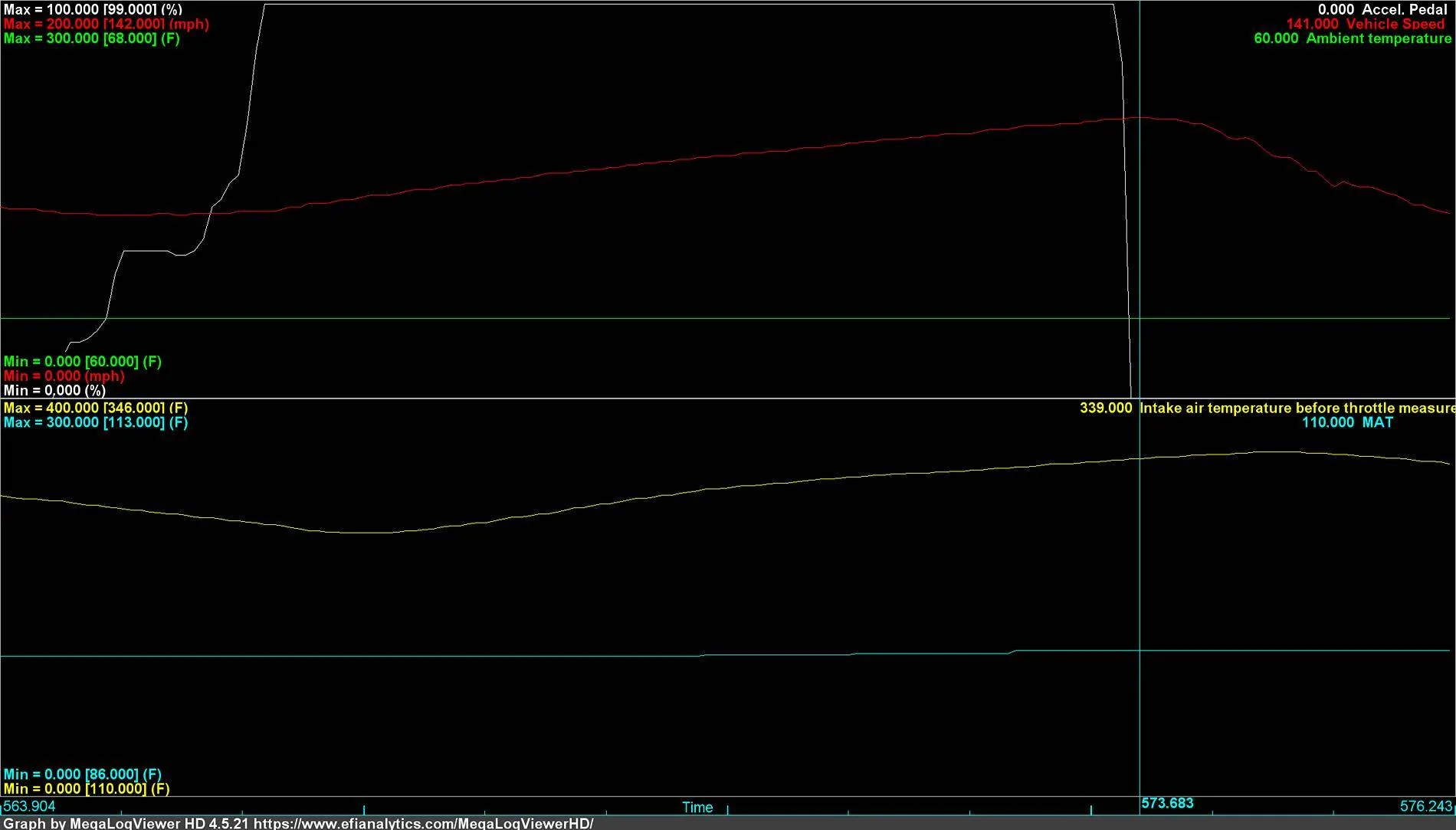
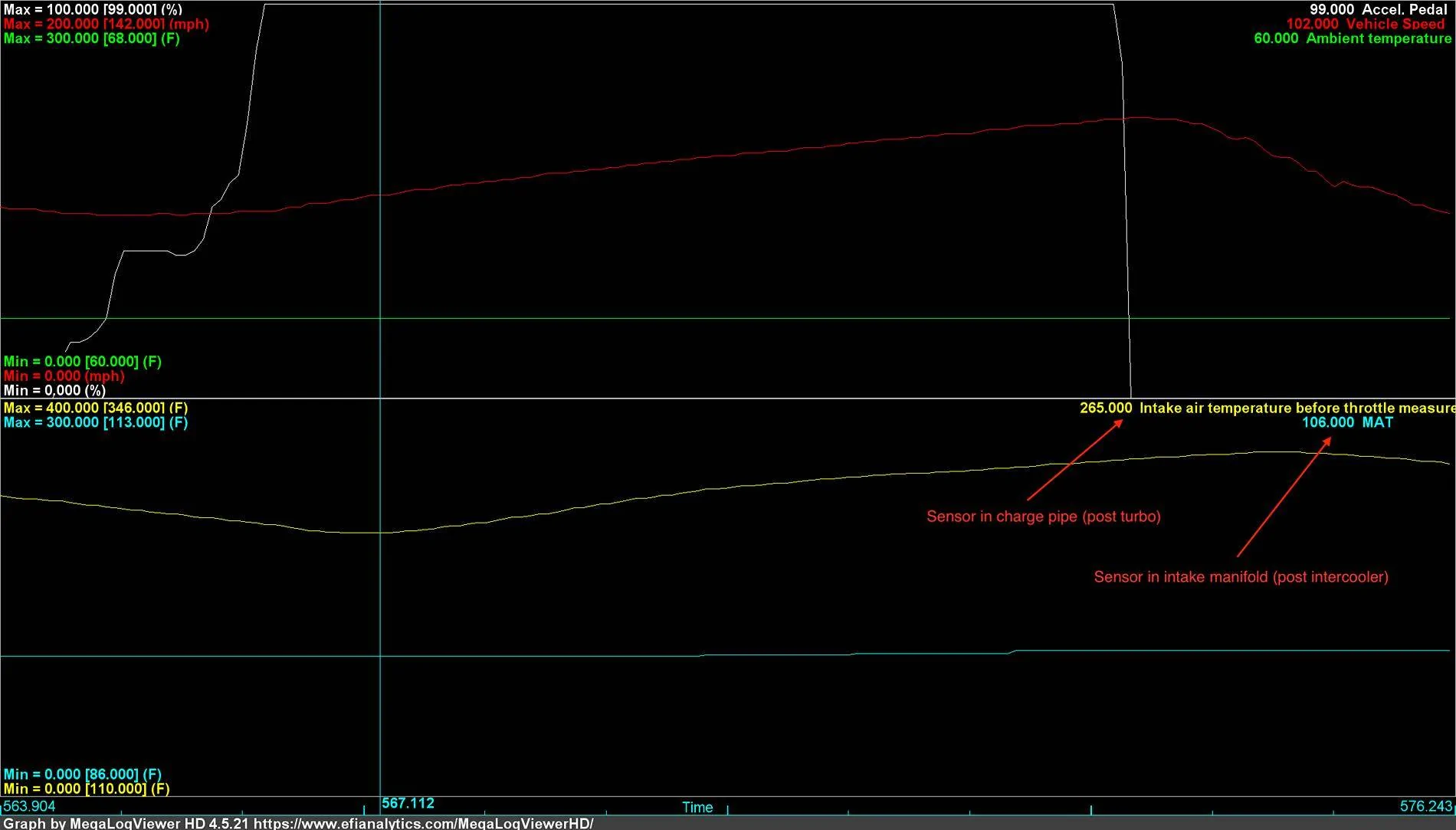
The hotter one is on the charge pipe. The other one is on the intake manifold after the intercooler.

Example of both sensors at WOT:

graph1.webp
graph2.webp
 
Last edited:
OP
OP
redflag973

redflag973

Member
First Name
Amin
Joined
Jul 3, 2022
Threads
2
Messages
12
Reaction score
4
Location
Bahrain
Car(s)
Toyota Supra 2022, Hyundai Accent 2017
The hotter one is on the charge pipe. The other one is on the intake manifold after the intercooler.

Example of both sensors at WOT:

graph1.jpg
graph2.jpg
Thanks for these graphs. Now I have a better idea, maybe it's worth directing air to the filterbox inlet. I have seen a couple of videos where in its stock form the car is almost choked and does not get airflow.

That's one option, another route would be to get a vented hood since I've noticed after pulls the heat sensor from under the hood that shows on the hidden features of the original gauge shows high temps.

One more route I might be going for which does not really affect the air in the filterbox but helps cooling is to go with the ADRO new bumper since it has less restrictions on air reaching the radiators.
 

razorlab

Well-Known Member
First Name
Bryan
Joined
Oct 2, 2021
Threads
29
Messages
8,568
Reaction score
16,798
Location
Hudson Valley, NY
Car(s)
Not a Corvette.
Thanks for these graphs. Now I have a better idea, maybe it's worth directing air to the filterbox inlet. I have seen a couple of videos where in its stock form the car is almost choked and does not get airflow.

That's one option, another route would be to get a vented hood since I've noticed after pulls the heat sensor from under the hood that shows on the hidden features of the original gauge shows high temps.

One more route I might be going for which does not really affect the air in the filterbox but helps cooling is to go with the ADRO new bumper since it has less restrictions on air reaching the radiators.
Better off investing time and money into cooling the intake charge. Hood vent helps but manifold is the real game changer.
 

i3igpete

Well-Known Member
Joined
May 16, 2022
Threads
44
Messages
1,255
Reaction score
1,486
Location
Chicago
Car(s)
2023 3.0L 8AT
Thanks for these graphs. Now I have a better idea, maybe it's worth directing air to the filterbox inlet.
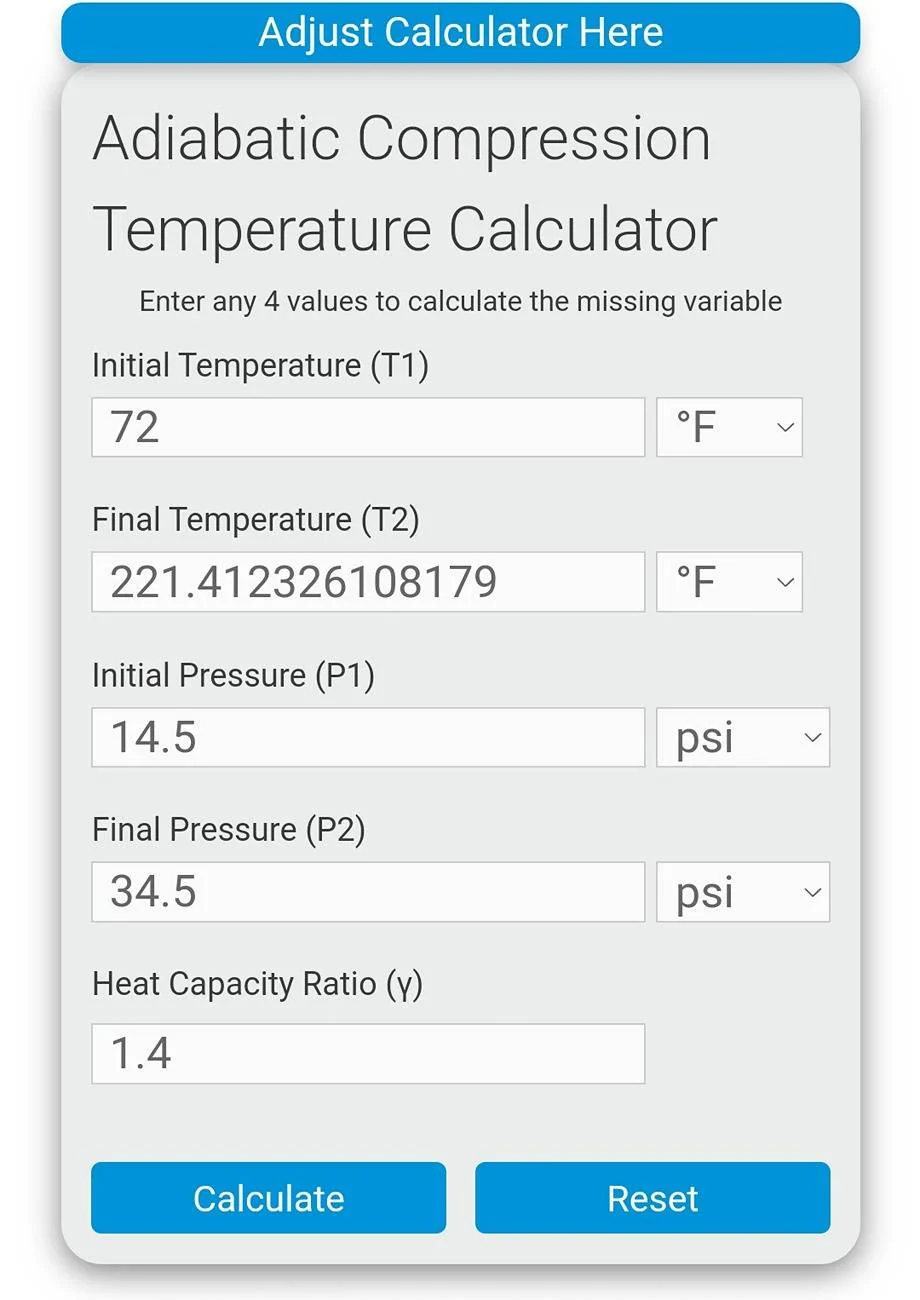
air will always heat when pressurized, because the compressor is performing physical work on the air. even with a magical 100% efficient compressor, things are already pretty hot.

example for 20 psi boost:

Screenshot_2024-10-22-08-29-09-41_40deb401b9ffe8e1df2f1cc5ba480b12.jpg


221-72=149

If you factor in the fact that compressors typically have a peak efficiency of 75-ish percent, multiply that temp rise by 1.3 to 1.4x or so. That is how you get air charge air temps in the neighborhood of 300 deg.

149*1.35=201

72 + 201 = 273

You can imagine that cooling the inlet air by 5 degrees is pretty much a throwaway. your time and effort are better spent on the intake manifold.
 
Last edited:

razorlab

Well-Known Member
First Name
Bryan
Joined
Oct 2, 2021
Threads
29
Messages
8,568
Reaction score
16,798
Location
Hudson Valley, NY
Car(s)
Not a Corvette.
air will always heat when pressurized, because the compressor is performing physical work on the air. even with a magical 100% efficient compressor, things are already pretty hot.

example for 20 psi boost:

Screenshot_2024-10-22-08-29-09-41_40deb401b9ffe8e1df2f1cc5ba480b12.jpg


221-72=149

If you factor in the fact that compressors typically have a peak efficiency of 75-ish percent, multiply that temp rise by 1.3 to 1.4x or so. That is how you get air charge air temps in the neighborhood of 300 deg.

149*1.35=201

72 + 201 = 273

You can imagine that cooling the inlet air by 5 degrees is pretty much a throwaway. your time and effort are better spent on the intake manifold.
df0d3c46c064a56f0c13debbcd67b94d.gif


But also agree. :)
Sponsored


Top