Sponsored

trash site

sw9991

New Member
First Name
Scott
Joined
Oct 24, 2024
Threads
0
Messages
3
Reaction score
0
Location
Lichfield
Car(s)
BMW M240i
Yeah I've tried the torque reductions in BM3, but with the stage 2+ OTS tune, it only works in 1st. I've tried with XHP as well, but again it only worked in 1st gear. It works with the stock BMW tune perfectly though. The theory from XHP was the DME wasn't reacting fast enough to regulate the boost - if that's the case, then I'm hoping the DME taking the reading directly from the table may enable it to act quicker than it having to process a request a secondary request from the transmission :dunno:

Anyway, I'm getting us slightly off your topic here....

I looked at the AFR tables yesterday, and your guide mention bank 1 and 2. I'm guessing these are set the same as each other?

Also, I'm running E20 so will look to adjust the ethanol % accordingly. What affect does changing that have? Does it link to the fuel scalar table?

Eagerly awaiting the next episode of Compressor Map With Required Compressor/Turbine Output (Kw) - Thanks again for the effort of writing these posts :)
Sponsored

 
OP
OP
razorlab

razorlab

Well-Known Member
First Name
Bryan
Joined
Oct 2, 2021
Threads
29
Messages
8,568
Reaction score
16,797
Location
Hudson Valley, NY
Car(s)
Not a Corvette.
I looked at the AFR tables yesterday, and your guide mention bank 1 and 2. I'm guessing these are set the same as each other?
Yea, I just set them the same

Also, I'm running E20 so will look to adjust the ethanol % accordingly. What affect does changing that have? Does it link to the fuel scalar table?
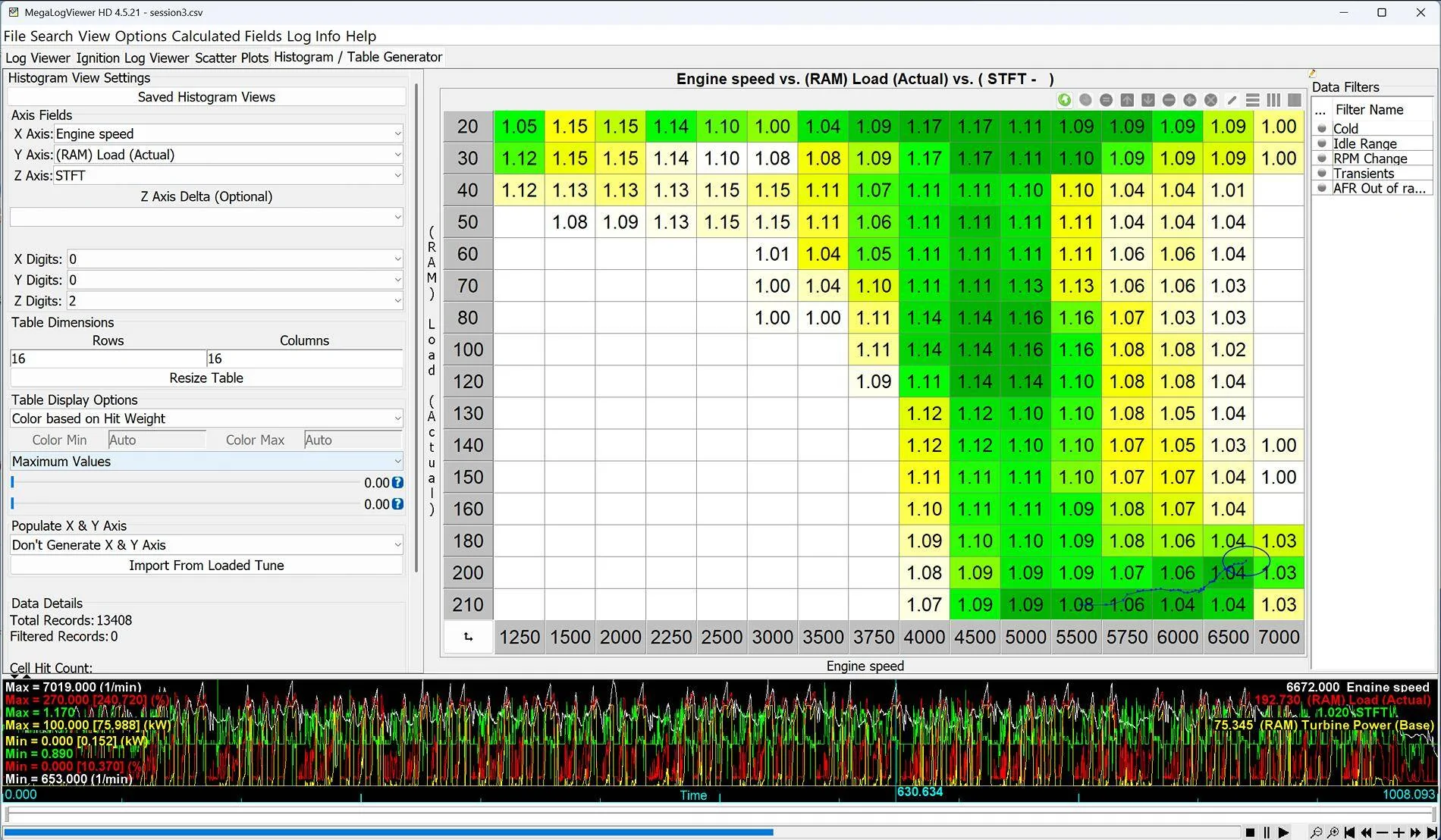
Yes, it's global as a 1D map, the scalar then is used for more granular tweaking. Best way to tune the 3D scalar table is logging STFT while driving in a bunch of different situations. I created a Histogram in MegaLogViewer and mapped the STFT onto the scalar table. Then I adjust the scalar table based on that. It's really powerful and helpful actually.

Screenshot 2024-10-25 at 9.57.45 AM.webp
 

i3igpete

Well-Known Member
Joined
May 16, 2022
Threads
44
Messages
1,255
Reaction score
1,486
Location
Chicago
Car(s)
2023 3.0L 8AT
I created a Histogram in MegaLogViewer and mapped the STFT onto the scalar table. Then I adjust the scalar table based on that. It's really powerful and helpful actually.
just had a flashback to AEM EMS that I completely forgot about. using Self tune, driving around, and then doing a diff of the old and new fuel tables. then grabbing the cells with the largest diff magnitudes to interpolate and generate the next iteration.
 
OP
OP
razorlab

razorlab

Well-Known Member
First Name
Bryan
Joined
Oct 2, 2021
Threads
29
Messages
8,568
Reaction score
16,797
Location
Hudson Valley, NY
Car(s)
Not a Corvette.
just had a flashback to AEM EMS that I completely forgot about. using Self tune, driving around, and then doing a diff of the old and new fuel tables. then grabbing the cells with the largest diff magnitudes to interpolate and generate the next iteration.
Hahha, yea I am a bit anal about some of this stuff. I doubt most tuners even bother.
 

sw9991

New Member
First Name
Scott
Joined
Oct 24, 2024
Threads
0
Messages
3
Reaction score
0
Location
Lichfield
Car(s)
BMW M240i
just had a flashback to AEM EMS that I completely forgot about. using Self tune, driving around, and then doing a diff of the old and new fuel tables. then grabbing the cells with the largest diff magnitudes to interpolate and generate the next iteration.
I fear self-tuning is going to be a slippery slope of always tinkering to see if it can be made to be better.... mix that in with manipulating excel data, and I can't think of anything else that could be more enjoyable!
 

kfer

Active Member
First Name
Feri
Joined
Mar 13, 2023
Threads
0
Messages
35
Reaction score
17
Location
hungary
Car(s)
Z4
So, rescale the Y-axis as needed and set the WGDC values to get close to what your boost to be, as a base. So if you are aiming for 24psi and 88% WGDC gets you that in 4th gear at 1600 MAF, at a .850 Turbine Distribution Factor, then consider that cel good. Rinse and repeat to get a tuned base boost curve. Good practice is to ramp WGDC in as Turbine Distribution Factor goes up. You can also enhance the response of the car by inflating these numbers past the 1:1 that the factory programming has.
Is this table temperature dependent? Basically, as the temperature increases, the air density decreases, so the turbo has to push more pressure to achieve the same MAF. So it could be that the distribution factor (or rather the associated WGDC%) is too low for the higher boost pressure. Or is the turbine distribution factor always the same for the desired MAF and the PID logic simply regulates accordingly ?
 
OP
OP
razorlab

razorlab

Well-Known Member
First Name
Bryan
Joined
Oct 2, 2021
Threads
29
Messages
8,568
Reaction score
16,797
Location
Hudson Valley, NY
Car(s)
Not a Corvette.
Is this table temperature dependent? Basically, as the temperature increases, the air density decreases, so the turbo has to push more pressure to achieve the same MAF. So it could be that the distribution factor (or rather the associated WGDC%) is too low for the higher boost pressure. Or is the turbine distribution factor always the same for the desired MAF and the PID logic simply regulates accordingly ?
There are temp compensations that, from what I have seen, affect boost target, which would slightly also affect this table as MAF airflow would change. I have noticed that PID does more of the heavy lifting here.

To be clear, I do not have all the answers here so am open to other input.
 

Rmak

Active Member
First Name
Ryan
Joined
Jun 13, 2024
Threads
1
Messages
31
Reaction score
22
Location
Vancouver BC, 51st State
Car(s)
GR Supra, Ferrari 458, Lexus GX, F350
Is this thread actually helping anyone? It takes a good amount of work to create these posts so if it's not actually helping anyone, I'll use that time for something else. :)
I just stumbled on this thread and it's immensely helpful! Along with a few of your other threads. Much appreciated.

I'm currently building my 2020 Supra for exclusively track days/time trials after running it stock for a season. Have been referencing your posts a lot.
 

rottmore

Well-Known Member
Joined
Jan 17, 2024
Threads
3
Messages
491
Reaction score
815
Location
illinois
Car(s)
guess
Shameless bump

I got a question with this Rev2 release
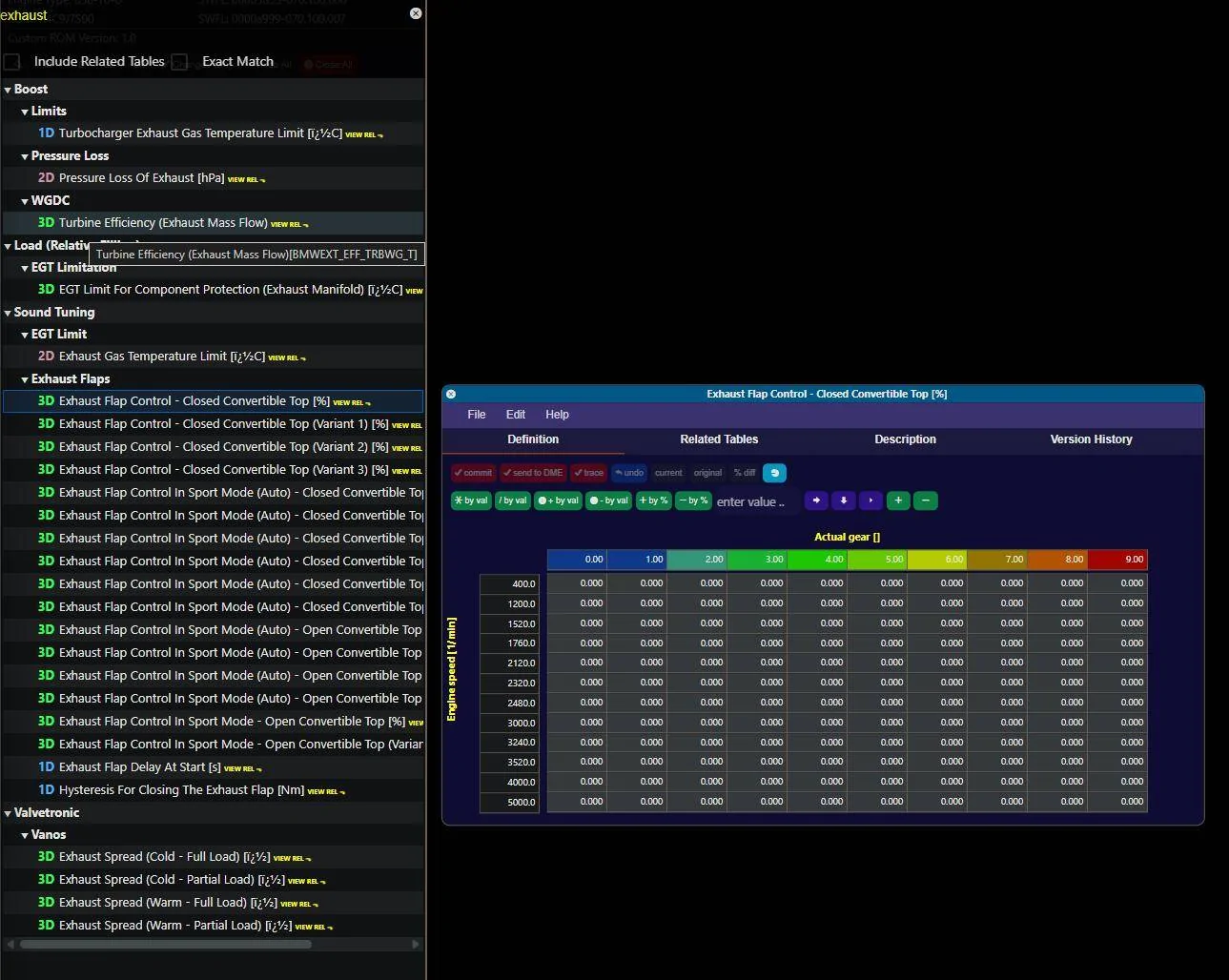
At first i couldn't understand why PTF would use the exhaust flap to control PI. Searched in the map editor and saw that we have a table for exhaust flap. Dafuq? So is this the table we use for PI now?
Screenshot 2025-03-20 081135.webp
 
OP
OP
razorlab

razorlab

Well-Known Member
First Name
Bryan
Joined
Oct 2, 2021
Threads
29
Messages
8,568
Reaction score
16,797
Location
Hudson Valley, NY
Car(s)
Not a Corvette.
Shameless bump

I got a question with this Rev2 release
At first i couldn't understand why PTF would use the exhaust flap to control PI. Searched in the map editor and saw that we have a table for exhaust flap. Dafuq? So is this the table we use for PI now?
Screenshot 2025-03-20 081135.jpg
I'm going to assume that is what they will be using but since I haven't seen a CustomRom2 yet, I'm not sure.

Also, there are a lot of tables that are and are not used across the platforms. For example, there are also radiator flap control tables, the Supra does not have those.
 
OP
OP
razorlab

razorlab

Well-Known Member
First Name
Bryan
Joined
Oct 2, 2021
Threads
29
Messages
8,568
Reaction score
16,797
Location
Hudson Valley, NY
Car(s)
Not a Corvette.
Bumping this thread reminded me of something.

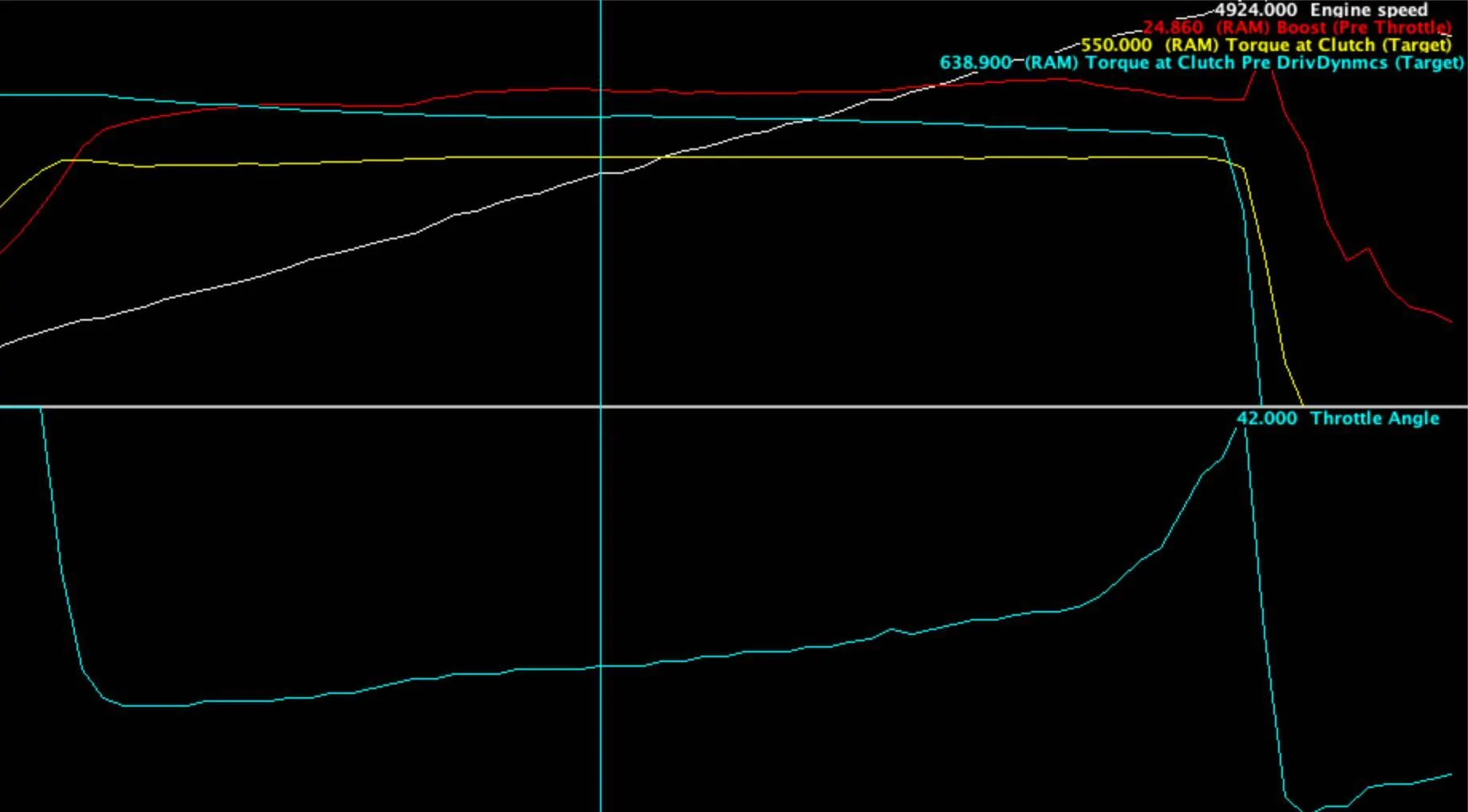
I discovered in Bootmod3, for certain ROM ID's, switching on the "TCU Torque Limit Patch" in map config doesn't actually work.

I was tuning a car without XHP and torque kept flat lining at 550nm even when DME table target was much higher, with the throttle plate shutting down the party. I eventually tuned it out in the actual ROM itself, because the map config setting obviously didn't work.

Screenshot 2025-03-20 at 9.50.29 AM.webp
 

Liu

Member
First Name
Liu
Joined
May 22, 2025
Threads
0
Messages
10
Reaction score
0
Location
china
Car(s)
BMW
Let's start talking about boost control.

You might have seen or heard some people stating that the B58 doesn't use a base WGDC table like other cars do, or like older Japanese cars do...

This is 100% incorrect. It uses a base WGDC to set, you guessed it, the base wastegate duty cycle, before any of the dynamic boost control starts.

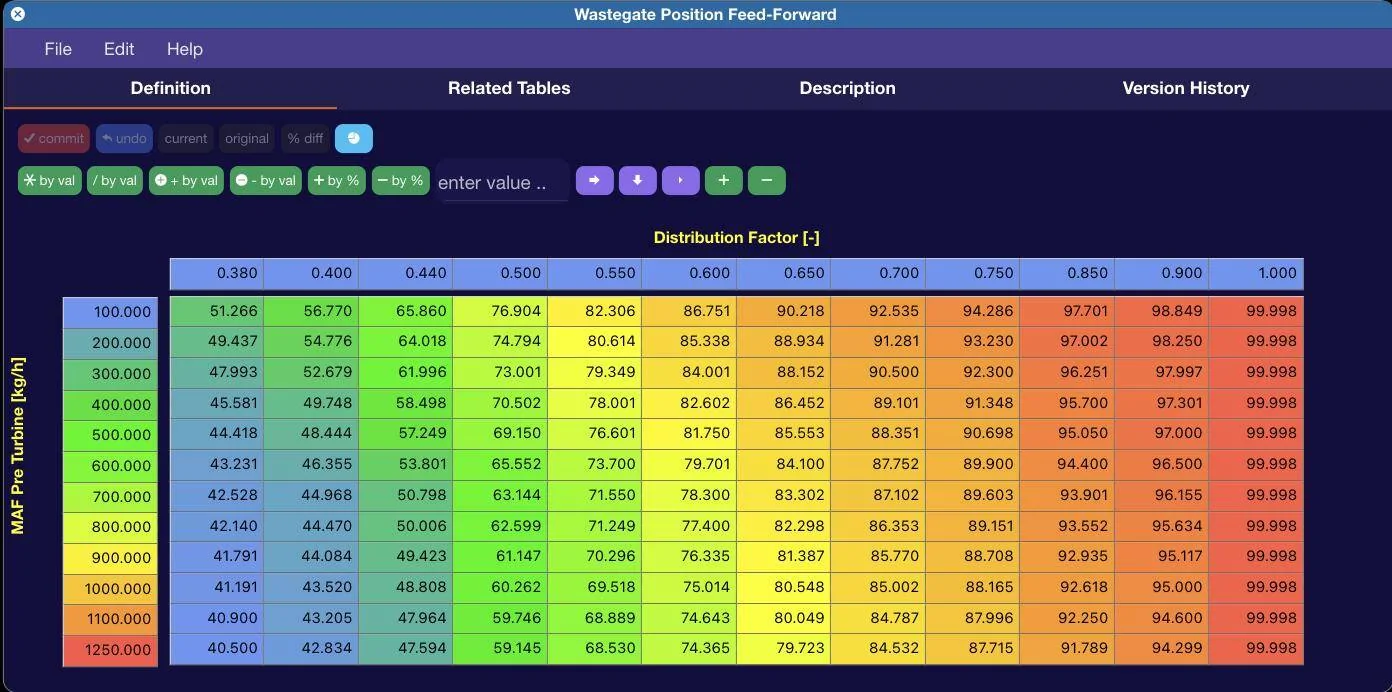
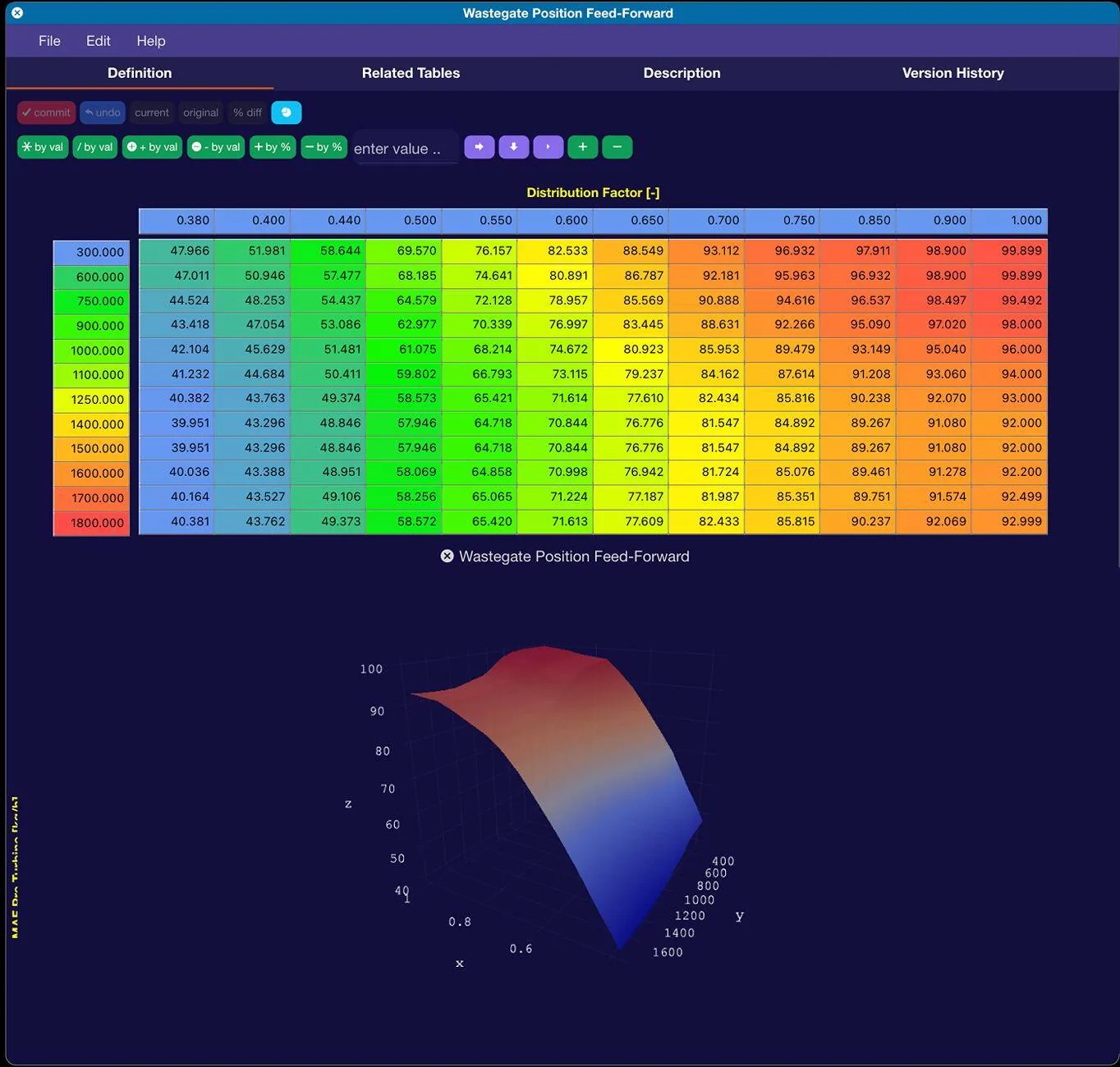
In our DME it's called the "Wastegate Position Feed-Forward" table and it looks like this:

Screenshot 2024-10-21 at 3.05.10 PM.jpg


It is best practice to get this table set to the WGDC needed to hit as close to your boost target as possible. Depending on the setup, you might want to buffer this a little bit and and understate the WGDC numbers a little bit and let the PID system add in the extra. This can help with boost spikes and such. We will get into the PID part of the system later.

The table has Turbine Distribution Factor on the X-axis, MAF Pre Turbine on the Y-axis, and Wastegate Duty as the values in the main section. How this table does differ from other cars is that there is no RPM axis, instead it does it by a combo of the two things on the X and Y axis. Turbine Distribution Factor is basically how much or how little amount of exhaust gases are passing through the wastegate (the flapper thing on the turbo). If all gases are passing through the wastegate, you get little to no boost. If the flapper is closed, you will get all the boostz. MAF Pre Turbine is, you guessed it, how much air flow you are shoving into the engine. Usually, more flow equals higher MAF numbers.

You will notice that with the OEM values, 99.998 wastegate duty cycle corresponds to a 1.00 Turbine Distribution Factor. All the duty used to basically close the door and hit maximum boost that the turbo is capable of. So the OEM programming is almost a nice 1:1. This works nicely on the oem setup. When upgrading the turbo and/or adding more free flowing other parts like an exhaust and such, you will want to tune this table a bit to get everything working well again, which is what I explained in the first paragraph above.

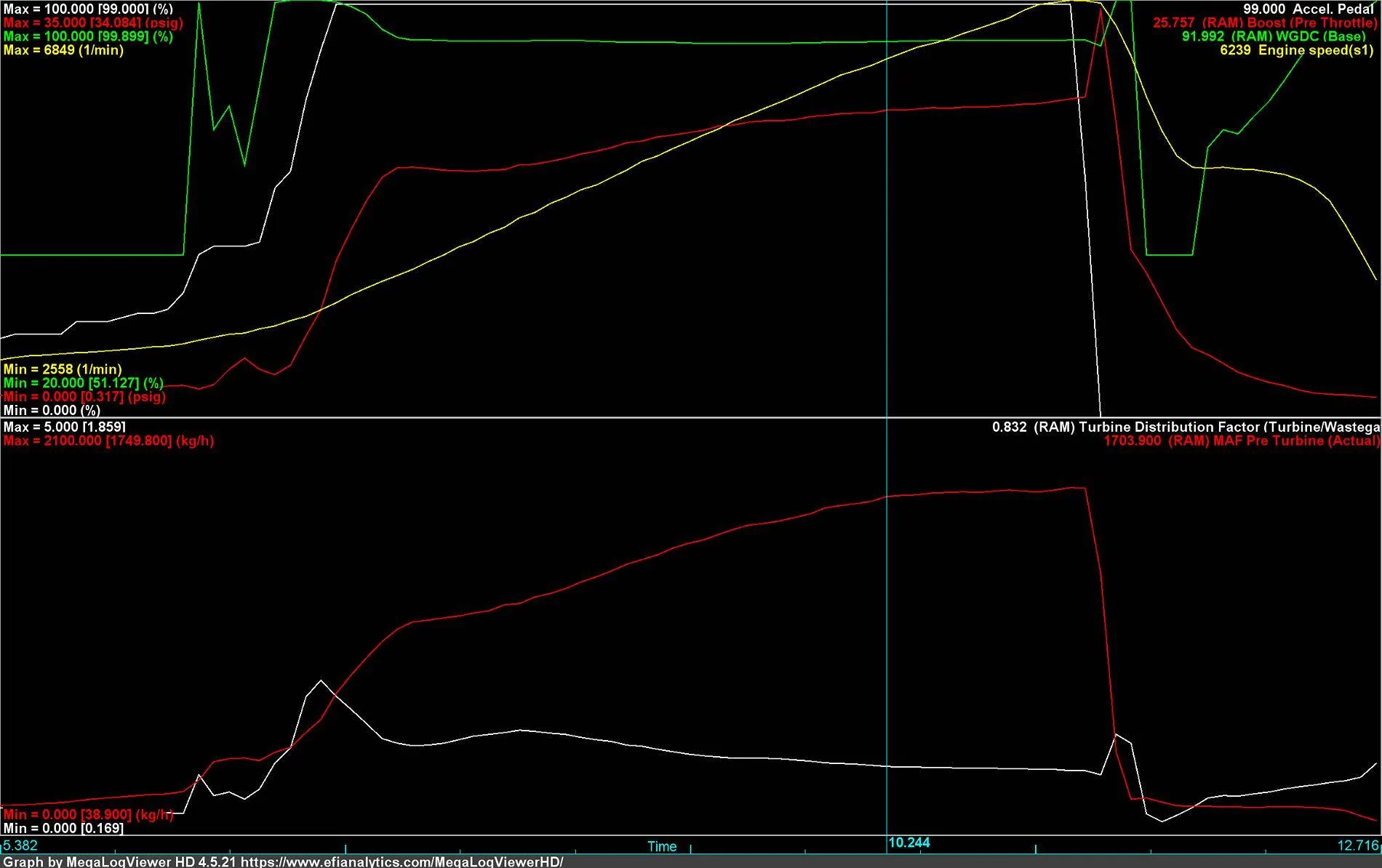
In order to tune this properly you need to datalog these items:

Boost (Pre Throttle)
WGDC (Base)
Turbine Distribution Factor (Turbine/Wastegate)
MAF Pre Turbine (Actual)

The following screenshot is with the dynamic PID boost control system turned off, so what is in this log is the DME running 100% off the Wastegate Position Feed-Forward table. Depending on how you like to tune, this might be a more helpful way to set the correct base WGDC for the boost desired before turning on the PID system and wrestling with it. If you are new to tuning, this will be a MUCH easier way to tune this table. You could even run straight off this table without dynamic PID control if you like, just know that you might/will run more/less boost depending on the environment, gear,etc. PID helps add/subtract to hit a certain boost level no matter the environment, gear, and driving style.

graph1.jpg


Right away you will notice that you will have to rescale the Y-axis to accommodate higher airflow numbers that a OEM turbo running higher boost than stock will hit, or an aftermarket turbo, that will have higher airflow at even the same boost numbers as the smaller OEM turbo.

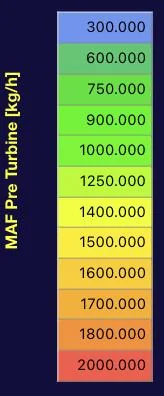
I run a Pure700 turbo and I rescaled my Y-axis like this:

Screenshot 2024-10-21 at 3.44.26 PM.jpg


This covers the range of airflow this turbo sees at the boost levels I have used.

As far as the X-axis goes, you will see that the car usually runs around .650 to .850 range at WOT, again, depending on the turbo and what boost levels you are running.

So, rescale the Y-axis as needed and set the WGDC values to get close to what your boost to be, as a base. So if you are aiming for 24psi and 88% WGDC gets you that in 4th gear at 1600 MAF, at a .850 Turbine Distribution Factor, then consider that cel good. Rinse and repeat to get a tuned base boost curve. Good practice is to ramp WGDC in as Turbine Distribution Factor goes up. You can also enhance the response of the car by inflating these numbers past the 1:1 that the factory programming has.

In the end, the general shape should look something like this:

Screenshot 2024-10-21 at 4.06.34 PM.jpg


Next up... The "Compressor Map With Required Compressor/Turbine Output (Kw)" which shifts the actual Turbine Distribution Factor being used, based on a certain Kw for the turbine to spin to hit the desired boost. Fun stuff!

Hi razorlab,

Thanks for the detailed explanation — it’s incredibly helpful!

You mentioned that the log screenshot was taken with the dynamic PID boost control disabled, and that it’s a good method to tune the Wastegate Position Feed-Forward table more accurately before re-enabling PID. That sounds like a great idea, and I’d like to try that approach.

Could you please clarify:

Which tables or parameters need to be modified to disable the PID system temporarily for tuning purposes?
Are the following tables sufficient to zero out?
• Boost Control Variable (PID) Floor
• Boost Control Variable (PID) Ceiling

Or are there additional steps required to fully disable PID intervention?

Thanks again for sharing your insights!
Sponsored


Top