Sponsored

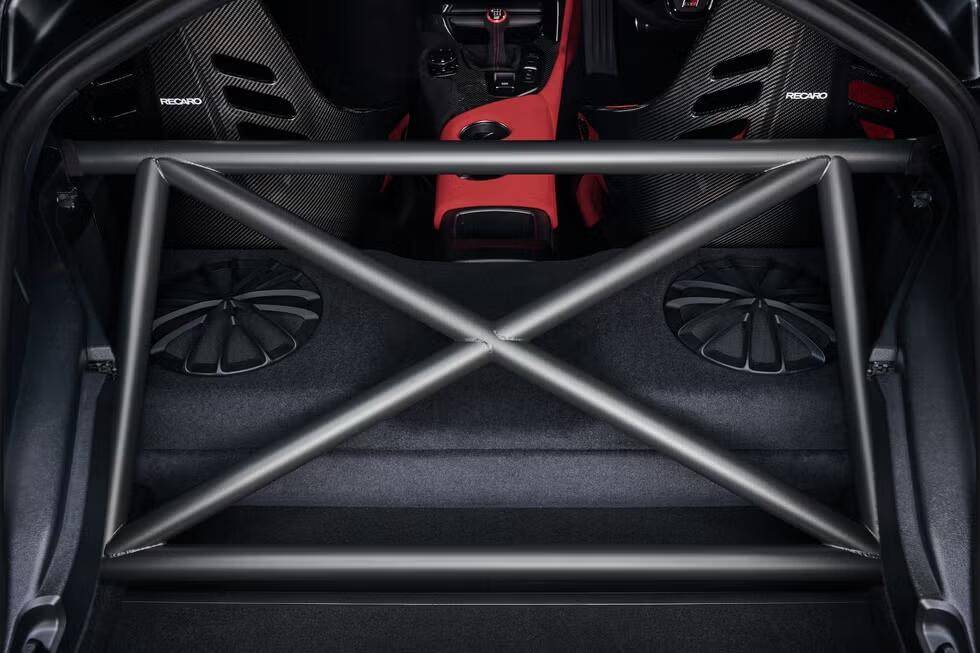
Has anyone switched this bar out?

GoldenEye

Well-Known Member
First Name
Golden
Joined
Jun 3, 2022
Threads
37
Messages
1,026
Reaction score
1,213
Location
WA
Car(s)
2022 Supra
I'm jumping in here with questions. I'm not an engineer and don't know about safety from these bars but I'm looking for a little more room to move my seat back but don't want to get decapitated if someone rear ends me either. I'm not going to run harnesses, just more room. What should I go with?
Sponsored


 

jonezj

Well-Known Member
First Name
Julian
Joined
Jun 27, 2020
Threads
4
Messages
65
Reaction score
42
Location
Maryland
Car(s)
2020 GR Supra 3.0
Cusco or hks bars are fine if you aren’t mounting a harness to it and just want legroom.
 

Kennith82

Well-Known Member
Joined
May 29, 2023
Threads
4
Messages
112
Reaction score
101
Location
United Arab Emirates
Car(s)
2022 Supra
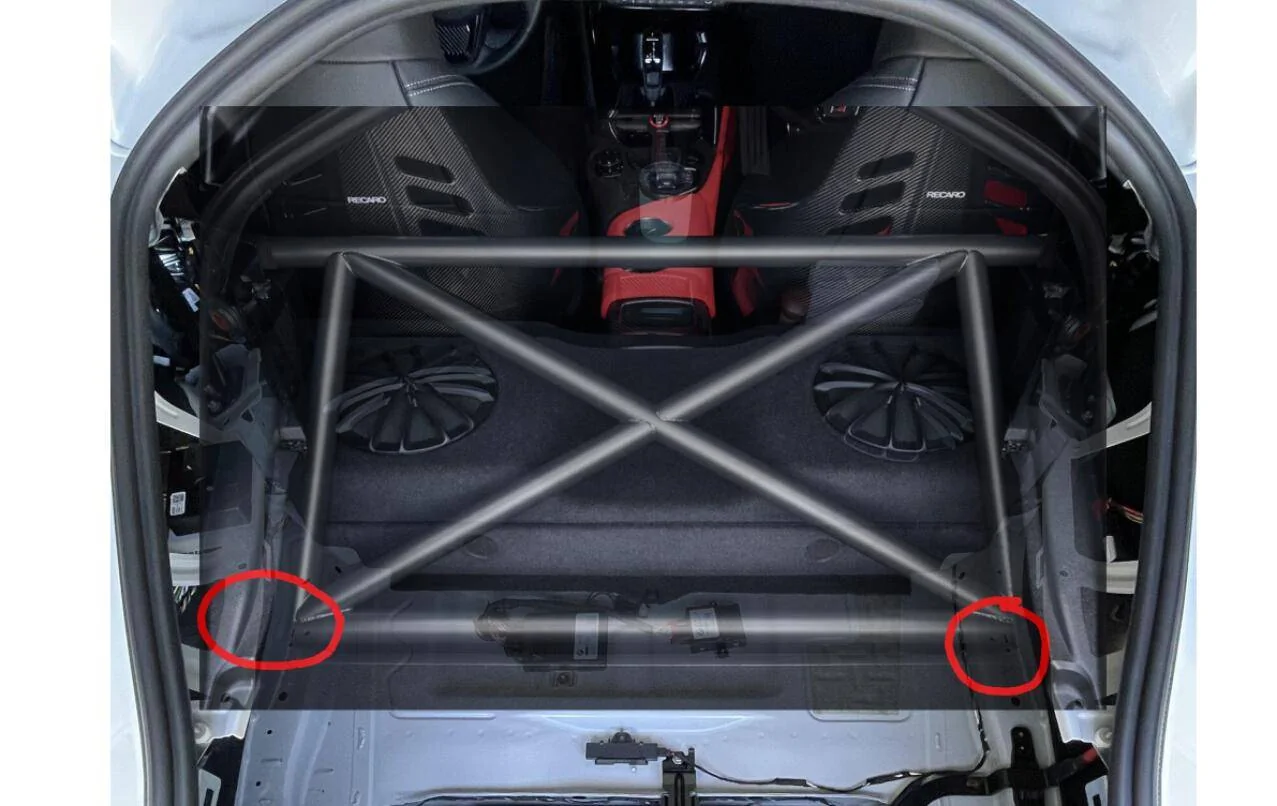
Anyone have an idea where the lower bar bolts into? Assuming top part either goes where the factory bar goes, either Cusco or USM, but I can't figure out if the bottom part bolts into existing places, or if Toyota/BMW added a dedicated spot for it.

1735072347343-ro.jpg
 

rwense

Well-Known Member
Silver Sponsor
First Name
Evan
Joined
Dec 10, 2021
Threads
45
Messages
706
Reaction score
1,136
Location
Pittsburgh, PA
Car(s)
21 Nitro Yellow A90 Supra, 10 Honda Fit Sport 5spd
Anyone have an idea where the lower bar bolts into? Assuming top part either goes where the factory bar goes, either Cusco or USM, but I can't figure out if the bottom part bolts into existing places, or if Toyota/BMW added a dedicated spot for it.

1735072347343-ro.jpg
If I had to guess, it would probably make use of some of these holes in the chassis. The scaling isnt quite correct but you get the idea

1735078078343-tx.webp
 

Strych9

Well-Known Member
Joined
Jun 3, 2025
Threads
2
Messages
54
Reaction score
67
Location
Ohio
Car(s)
2021 3.0
Sorry to necro this thread, but this is one of the first 3 threads that come up when searching for a rear tower brace that gives more leg room. Plus, 6 months isn't that bad of a necro and a lot of these points need addressing.

I disagree with you about the mounting points not holding. You made the claim and I'd like to know your basis for it. There are thousands of these cars driving around counting on the harness bars being an effective safety device.
Thousands don't make it right. Pulling on a bar in the middle of it is bad from paper to practice. A squat bar is pretty damn good steel and some of the best are made from heat treated 4140, which is pretty well 4340 by that point. Both of these are better than 4130 which is the higher end of what cage materials you'll commonly find. If you can bend a solid bar of heat treated 4140 with 500lb on it, do you really want to trust your body weight shock loading a lower grade of steel, in tube form instead of bar stock, that I can almost promise you isn't heat treated?

This isn't to say that 4130 is insufficient (it's usually overkill), it's just an elaboration on cage and chassis engineering basics. You never rely on the weld or the material, you rely on the design. In this case, the design of using 1.25, 1.375, or 1.5" tube in bending as a harness bar is a gigantic no-go.


His “bolt in” roll/harness bar is space efficient but i’m not sure about how it will cert out at a track yet for competition.
Bolt-in cages can be okay, but this is usually extremely circumstantial once you get to the higher level. Even then, you're only looking at partial sections and a lot of extra work that would result in more work than a weld-in cage. I can say that a cage that's welded together and bolted in place will mostly retain it's shape when you need it to do it's job, but this is like getting in a big box with a smaller box, and expecting the smaller box to keep the big box from collapsing on you. If I had to, I would build myself a bolt in cage, but I wouldn't trust anyone else to do it and I wouldn't do it for anyone else.


how do you know the Cusco bar is stiffer Than the stock bar?

and I hope you understand that the only difference that matters, as far as chassis rigidity, is tension and compression. Not torsional rigidity or shear modulus.
If someone can get me an ID and OD on the tube, I can answer this question.

I'm not sure on the wording here, so I'll just clarify for any future readers. Chassis stiffness is a matter of torsional stiffness. How that bar plays into it is in compression (as well as compression buckling) and tension.


Call a reputable cage builder and ask them. They will say it’s not a good idea for a wide range of reasons.

Just because there are thousands of people doing this doesn’t make it a good idea. Many of these bars are only rated or tested to DOT standards(if they even test them), which is not even close to the same thing as SFI, ASN, KNAF, FIA, or NHRA specs. These parts won’t carry one of those ratings because they simply aren’t strong enough. Anyone that builds structural parts knows a straight line with a perpendicular load isn’t going be strong enough for an application like this and that’s why all cages use a collection of triangles supporting the direction of loads it’s designed to hold.

That being said the mounting point holding or not is just one of several issues with these bars. Call a cage builder and get their opinion if you don’t (rightfully) believe people on the internet.
After being on the manufacturing side of things and knowing what it costs to make these kinds of parts, a quick check on prices tells me that MAYBE 1 of them is built to MAYBE 1-2 rule books, but I would be very surprised if any of them is ACTUALLY rated by any sanctioning body or DOT.

Getting written certification from a sanctioning body is already hard enough since they don't want the liability, they'll need the involvement of a stamped engineer, all QC and material paperwork, and all the other legal BS.


The stock bar is aluminum, and the Cusco bar is steel. Generally steel has a higher yield strength and tensile strength than aluminum. It also has as a Young's modulus that's much higher than aluminum, making it much stiffer.

Obviously this may not directly translate to just popping in the bar and having a X percent stiffer chassis in that area, because we don't know how forces acting on the car translate to the bar, but the Cusco bar is stiffer. That's why I said it potentially could have an effect under the right load, but there's no performance based reason to actually do it.
Stiffness is a concern of material, cross section, and outside dimensions. Steel has aluminum beat on the first one. The rest are questionable without dimensions. Your major concern is buckling under compression. If you made a steel one of the same dimensions as the stock unit, you'd be drastically stiffer.

Just purely from a standpoint of compression and tension, a 3/8 x .023 tube can likely do the job, but it's a matter of it buckling once compressed. That's where outside diameter becomes king.

We (as a community) likely don't know the forces acting on the car off the top of our heads, but we can get pretty damn close just by reverse engineering that bar and removing the load factors.


I have seen two or three roll bars tops that are engineered correctly. Anything bolted to those stamped sheet metal parts that get pinch welded.... better go to church if you are putting your car on a fast paced track.

To say the material is stronger is even crazier as the supporting material it is bolted to will come right out in the event of a very bad high impact. Enough said here. The more expensive bars are engineered correctly for a particular reason. SAFETY!
I agree with all of this, but a good rule of thumb with any fabricated aftermarket parts is to never, ever, ever assume it is engineered in the typical sense.

I'm pricing out making my own brace at the moment. My entire method is this: take the outside diameter of tube of the bar I'm planning on (1-3/8"), divide that by the width of the stock bar, then multiply that by the added strength of the material I'm planning on vs. the stock unit, then go with a wall thickness to overshoot the difference. Take the wall thickness of the stock unit, use that same wall thickness in the new material and transition from the round tube to the mounting surface. Measure for material, draft and order laser cut/bent parts, box the ends, weld it up, install. Basically, "what did OEM do? I'm gonna overshoot that. If it has to race, we'll hop on the computer."

95% of engineered parts are kind of engineered, but they're done in this same exact way and they usually work. When you do it for as long as some of us have, it'll work.

Sorry for the long post, but this thread is a top result in google and the information is very much in my wheelhouse.
 

razorlab

Well-Known Member
First Name
Bryan
Joined
Oct 2, 2021
Threads
29
Messages
8,568
Reaction score
16,796
Location
Hudson Valley, NY
Car(s)
Not a Corvette.
Lmao. Cusco has unfortunately been tested in crashes. Works fine. Doesn’t do what people on the internet say.

Real life > white paper theory

Also as an FYI, @D_A_S is a crook, has since closed his “businesses” and has multiple cases against him. So def the LAST horrible human you want to listen to or agree with.
 

Strych9

Well-Known Member
Joined
Jun 3, 2025
Threads
2
Messages
54
Reaction score
67
Location
Ohio
Car(s)
2021 3.0
I don't take any of what I advised from the internet. Professional motorsports fabrication has paid more of my bills than anything else that I've ever been involved with.

On that note, "I seent it" isn't going to alter how I advise people on how to approach what it is that I do for a living. A broom stick is fine for most everyone that'll ever drive a Supra; doesn't mean it's going to do it's job when someone requires it to.

I wouldn't recommend any straight, non-triangulated harness bar solution for any serious racing, period. If you somehow knew that you'd only be involved in side impacts or roll overs, they'd be more than enough as a harness bar. As for how well they do for chassis stiffness, I'd say it's fine. Ideal? No. Fine? Sure.

Additionally, I don't care one bit in the world about who the information comes from. I care about the information.
 

razorlab

Well-Known Member
First Name
Bryan
Joined
Oct 2, 2021
Threads
29
Messages
8,568
Reaction score
16,796
Location
Hudson Valley, NY
Car(s)
Not a Corvette.
I don't take any of what I advised from the internet. Professional motorsports fabrication has paid more of my bills than anything else that I've ever been involved with.

On that note, "I seent it" isn't going to alter how I advise people on how to approach what it is that I do for a living. A broom stick is fine for most everyone that'll ever drive a Supra; doesn't mean it's going to do it's job when someone requires it to.

I wouldn't recommend any straight, non-triangulated harness bar solution for any serious racing, period. If you somehow knew that you'd only be involved in side impacts or roll overs, they'd be more than enough as a harness bar. As for how well they do for chassis stiffness, I'd say it's fine. Ideal? No. Fine? Sure.

Additionally, I don't care one bit in the world about who the information comes from. I care about the information.
But you don’t care about my real world information? These were frontal collisions. It did the job when it was required to.

Real world > white paper theory
 

Strych9

Well-Known Member
Joined
Jun 3, 2025
Threads
2
Messages
54
Reaction score
67
Location
Ohio
Car(s)
2021 3.0
But you don’t care about my real world information? These were frontal collisions. It did the job when it was required to.

Real world > white paper theory
Lay the info out. There's always more to it.

What's this whole "white paper theory" thing you keep on about?

Random guy on the internet says don't trust the internet, then expects me to ignore 20 years of motorsports fabrication experience because he saw a few that didn't fail? I'm all ears.
Sponsored


Top