
Sponsored
Loading


concept
Well-Known Member
- First Name
- Dave
- Joined
- Sep 1, 2023
- Threads
- 31
- Messages
- 1,153
- Reaction score
- 810
- Location
- Southern CA
- Car(s)
- 2024 Supra 45th, Mikan 2008 Mazda MX5 PRHT manual
If what you state is true, then why not use 20W-50 weight oil? After all, higher viscosity is always better for wear, right? Wrong. It's all about bearing/journal clearances and oil temperature. I have yet to see a group of Supras going on a road trip, averaging 120 mph on a 110 degree day.Last time i checked the supra was a sports car. Even on the street and highway, majority of supra's will see High load scenarios. Application dictates chemistry. Higher viscosity offers more protections from wear. Did you bother watching till the end of the video to see the bearing wear results?
Liqui moly is a lot of marketing and pushes oil additives, IMO stay away from brands like that. Especially when a same LL01 brand at Walmart offers the same protection at a cheaper price.


Certainly, if I lived in Germany and averaged 120+ for extended time periods on the Autobahn as a daily commute, I'd be using thicker oil and monitoring its temperature. But any speeds exceeding 120 for more than 10 seconds here in CA is extremely dangerous, both for the driver and for the life of that driver's license.
OP
OP

razorlab
Well-Known Member
- Thread starter
- #48
If what you state is true, then why not use 20W-50 weight oil? After all, higher viscosity is always better for wear, right? Wrong. It's all about bearing/journal clearances and oil temperature. I have yet to see a group of Supras going on a road trip, averaging 120 mph on a 110 degree day.
Certainly, if I lived in Germany and averaged 120+ for extended time periods on the Autobahn as a daily commute, I'd be using thicker oil and monitoring its temperature. But any speeds exceeding 120 for more than 10 seconds here in CA is extremely dangerous, both for the driver and for the life of that driver's license.


mdpalmer
Well-Known Member
- First Name
- Mike
- Joined
- Feb 6, 2023
- Threads
- 3
- Messages
- 121
- Reaction score
- 258
- Location
- Los Angeles, CA
- Car(s)
- 2023 GR Supra 3.0 MT
I didn't see it posted in this thread but thought this was a good read lots of info summaized in one place, I believe this is from a credible source:
https://www.bimmerworld.com/BMW-Engine-Oil/#oilrecs
Also see bimmerworlds oil recommendations attached.
So the takeaway is if you frequently beat on the car, especially when its (oil is) hot, factory spec oil probably isn't best choice for engine protection.
My opinion it is probably ok for the kind of person who has a stock engine, emissions system, turbo, uses pump fuel, drives the car in traffic, and actually uses the start-stop function (I personally don't), cares about fuel consumption and the environment, etc.
Only way to really know is used oil analysis. Since I had the car brand new, I have 2 UOA reports so far that show no cause for concern on the 0W-20 LL-17 FE+ spec oil. I'm not a track junky, but do enjoy the car, regularly beaten on every drive. Stock engine, pump gas. I live in SoCal so temperate climate and stuck in traffic often.
That said I will switch to a 5W-30 that meets the LL-01/04 spec after my warranty runs out. I'll continue the UOAs and see how it goes.


https://www.bimmerworld.com/BMW-Engine-Oil/#oilrecs
Also see bimmerworlds oil recommendations attached.
So the takeaway is if you frequently beat on the car, especially when its (oil is) hot, factory spec oil probably isn't best choice for engine protection.
My opinion it is probably ok for the kind of person who has a stock engine, emissions system, turbo, uses pump fuel, drives the car in traffic, and actually uses the start-stop function (I personally don't), cares about fuel consumption and the environment, etc.
Only way to really know is used oil analysis. Since I had the car brand new, I have 2 UOA reports so far that show no cause for concern on the 0W-20 LL-17 FE+ spec oil. I'm not a track junky, but do enjoy the car, regularly beaten on every drive. Stock engine, pump gas. I live in SoCal so temperate climate and stuck in traffic often.
That said I will switch to a 5W-30 that meets the LL-01/04 spec after my warranty runs out. I'll continue the UOAs and see how it goes.
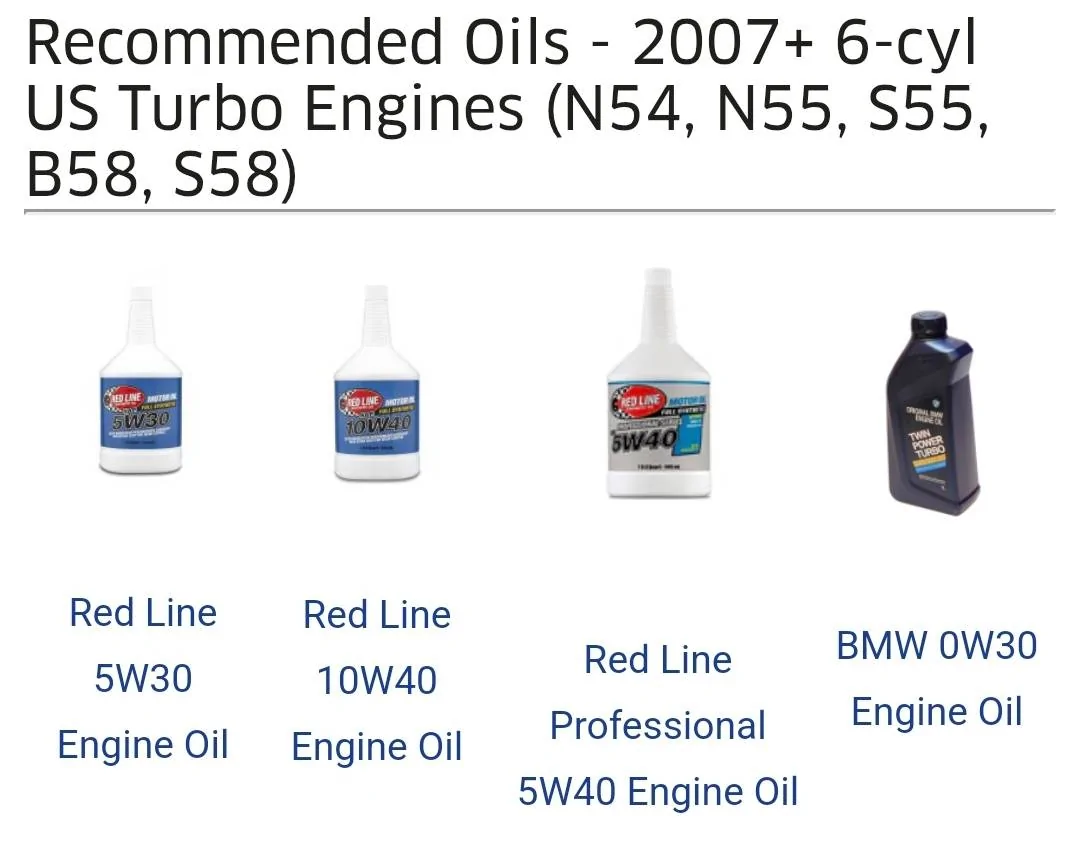
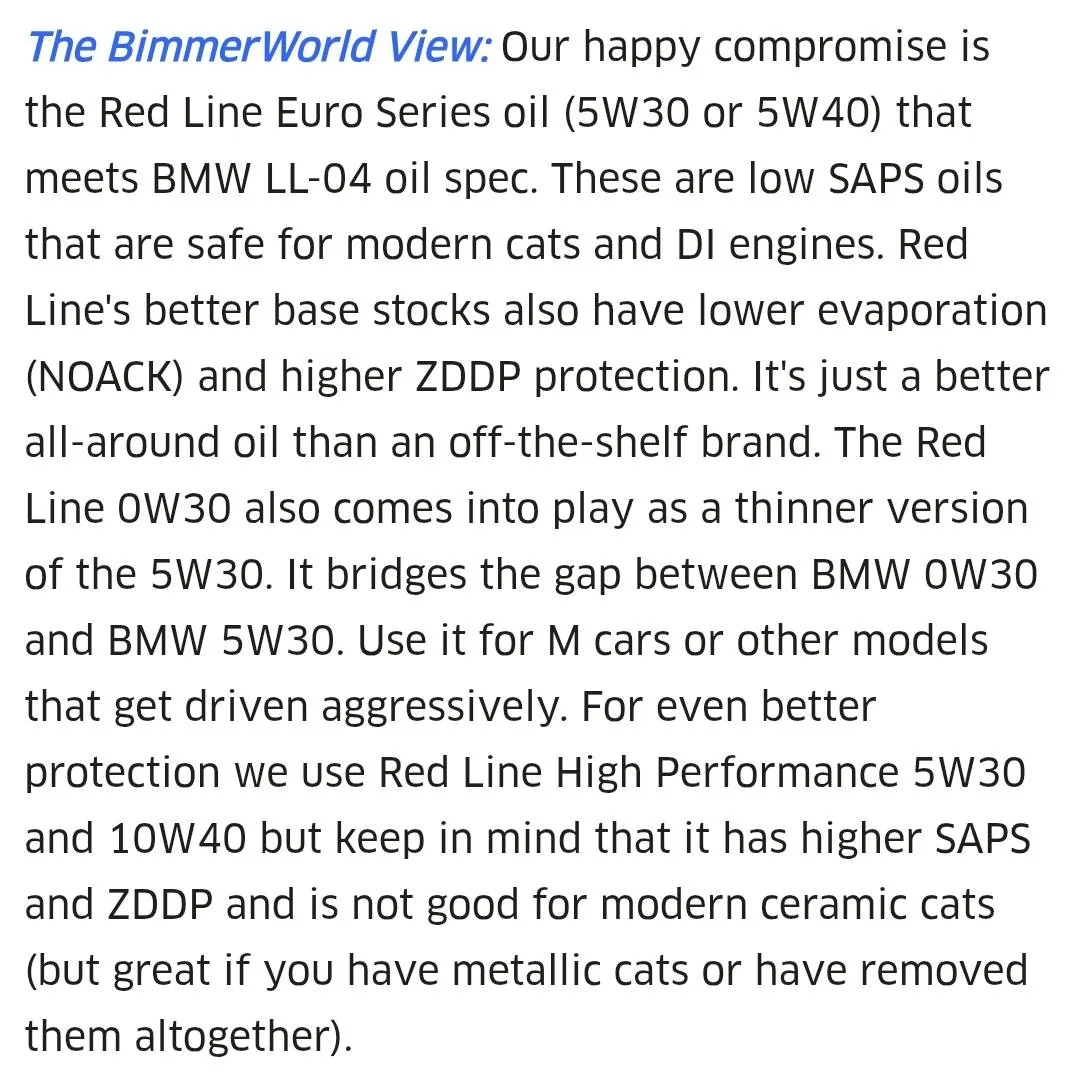
Last edited:
rottmore
Well-Known Member
What i stated was over simplified.If what you state is true
this is why i linked you lake speed jr videos. Someone who you can trust with test data and years of experience.
Last edited:
concept
Well-Known Member
- First Name
- Dave
- Joined
- Sep 1, 2023
- Threads
- 31
- Messages
- 1,153
- Reaction score
- 810
- Location
- Southern CA
- Car(s)
- 2024 Supra 45th, Mikan 2008 Mazda MX5 PRHT manual
I believe that because Lake's background is oil-testing, he is good with low-viscosity synthetic oils if testing results are good. At some point in one of his videos, he even sided with manufacturer's recommendations.What i stated was over simplified.
this is why i linked you lake speed jr videos. Someone who you can trust with test data and years of experience.

concept
Well-Known Member
- First Name
- Dave
- Joined
- Sep 1, 2023
- Threads
- 31
- Messages
- 1,153
- Reaction score
- 810
- Location
- Southern CA
- Car(s)
- 2024 Supra 45th, Mikan 2008 Mazda MX5 PRHT manual
I'd add that beating on the car for extended periods of time. In Southern Cali, this is a recipe for a reckless driving charge.I didn't see it posted in this thread but thought this was a good read lots of info summaized in one place, I believe this is from a credible source:
https://www.bimmerworld.com/BMW-Engine-Oil/#oilrecs
Also see bimmerworlds oil recommendations attached.
So the takeaway is if you frequently beat on the car, especially when its (oil is) hot, factory spec oil probably isn't best choice for engine protection.
I'd add ..."driving normally, most of the time with occasional brief bursts of speed beyond 100 mph."My opinion it is probably ok for the kind of person who has a stock engine, emissions system, turbo, uses pump fuel, drives the car in traffic, and actually uses the start-stop function (I personally don't), cares about fuel consumption and the environment, etc.
If your oil temps are spiking beyond 230 or 240°F, then your comment below may be warranted. Are you blasting up to 150 on the way to Vegas?Only way to really know is used oil analysis. Since I had the car brand new, I have 2 UOA reports so far that show no cause for concern on the 0W-20 LL-17 FE+ spec oil. I'm not a track junky, but do enjoy the car, regularly beaten on every drive. Stock engine, pump gas. I live in SoCal so temperate climate and stuck in traffic often.
I'd be interested to see if your oil analysis, one year after switching is the same or significantly better.That said I will switch to a 5W-30 that meets the LL-01/04 spec after my warranty runs out. I'll continue the UOAs and see how it goes.
[/QUOTE]
As per your oil analysis, your aggressive driving is not harming your engine with the stock oil.I didn't see it posted in this thread but thought this was a good read lots of info summaized in one place, I believe this is from a credible source:
https://www.bimmerworld.com/BMW-Engine-Oil/#oilrecs
Also see bimmerworlds oil recommendations attached.
So the takeaway is if you frequently beat on the car, especially when its (oil is) hot, factory spec oil probably isn't best choice for engine protection.
I live in Southern Cali, also, yet seldom get caught in traffic or use the start/stop. And based upon my interaction with many Supra owners here, driving at 120+ mph speeds for more than 5 seconds is rare on the streets/highways. Their insurance is high enough already.My opinion it is probably ok for the kind of person who has a stock engine, emissions system, turbo, uses pump fuel, drives the car in traffic, and actually uses the start-stop function (I personally don't), cares about fuel consumption and the environment, etc.
But based upon your oil analysis results, your 0W-20 oil is doing just fine, correct?Only way to really know is used oil analysis. Since I had the car brand new, I have 2 UOA reports so far that show no cause for concern on the 0W-20 LL-17 FE+ spec oil. I'm not a track junky, but do enjoy the car, regularly beaten on every drive. Stock engine, pump gas. I live in SoCal so temperate climate and stuck in traffic often.
I'd be interested to see if your thicker oil produces better oil analysis results.That said I will switch to a 5W-30 that meets the LL-01/04 spec after my warranty runs out. I'll continue the UOAs and see how it goes.

mdpalmer
Well-Known Member
- First Name
- Mike
- Joined
- Feb 6, 2023
- Threads
- 3
- Messages
- 121
- Reaction score
- 258
- Location
- Los Angeles, CA
- Car(s)
- 2023 GR Supra 3.0 MT
I don't condone reckless driving on the street, my definition of "beating on the car" may be different than yours.
My point was that so far I don't have a compelling reason to swap out the oil for something else.
Everyone that really wants to know how the oil is working for their use case should get regular UOA done to establish trends and if action should be taken IMO.
Track driving is a whole different thing (level of stress on the engine and the entire car, really) so those guys really need to pay attention to this but for your average person with a stock Supra, it probably doesn't matter at the end of the day, especially if you don't plan on keeping the car long term.
My point was that so far I don't have a compelling reason to swap out the oil for something else.
Everyone that really wants to know how the oil is working for their use case should get regular UOA done to establish trends and if action should be taken IMO.
Track driving is a whole different thing (level of stress on the engine and the entire car, really) so those guys really need to pay attention to this but for your average person with a stock Supra, it probably doesn't matter at the end of the day, especially if you don't plan on keeping the car long term.
I'd add that beating on the car for extended periods of time. In Southern Cali, this is a recipe for a reckless driving charge.
I'd be interested to see if your thicker oil produces better oil analysis results.
Last edited:
concept
Well-Known Member
- First Name
- Dave
- Joined
- Sep 1, 2023
- Threads
- 31
- Messages
- 1,153
- Reaction score
- 810
- Location
- Southern CA
- Car(s)
- 2024 Supra 45th, Mikan 2008 Mazda MX5 PRHT manual
Same here. I will get my first at-home oil change oil tested. My assumption is that its results will be similar to yours. My annual mileage will probably be 5000 or less, on average.I don't condone reckless driving on the street, my definition of "beating on the car" may be different than yours.
My point was that so far I don't have a compelling reason to swap out the oil for something else.
Everyone that really wants to know how the oil is working for their use case should get regular UOA done to establish trends and if action should be taken IMO.
Track driving is a whole different thing (level of stress on the engine and the entire car, really) so those guys really need to pay attention to this but for your average person it probably doesn't matter at the end of the day, especially if you don't plan on keeping the car long term.
RedSupra
Well-Known Member
When I was in Germany I would go 110 to 120mph in my E32 (1988 730i) down the Autobahn all the time. One time I buried the needle going over 240kph but the car was pretty floaty so I slowed down.If what you state is true, then why not use 20W-50 weight oil? After all, higher viscosity is always better for wear, right? Wrong. It's all about bearing/journal clearances and oil temperature. I have yet to see a group of Supras going on a road trip, averaging 120 mph on a 110 degree day.
Certainly, if I lived in Germany and averaged 120+ for extended time periods on the Autobahn as a daily commute, I'd be using thicker oil and monitoring its temperature. But any speeds exceeding 120 for more than 10 seconds here in CA is extremely dangerous, both for the driver and for the life of that driver's license.
When I changed the oil I just put in whatever viscosity it called for and whatever was the cheapest oil I could get.
I would drive that car across Germany, Luxemburg, Belgium, and Holland at high speeds for hours at a time and never gave much thought about oil as much as many do here. I know it had an older engine and tolerances were different etc. but I think we are overcomplicating something that should be.
Yes manufacturers need to meet CAFE standards which means that 0w-20 might not be the best oil for the longevity of the engine but will help get a little better mpg to meet those standards. Just evaluate how you drive your Supra then get a good reputable oil in a viscosity to meet your driving habits and meets the requirements for this car.
ETA:
So I guess my point is to not go bar hopping in Heidelberg and drink too much then have your friends stop at McDonald's for a shitty egg McMuffin for breakfast because 20 minutes later when your going 120mph down the Autobahn and you have to stick your head out the window because you have to puke, it makes a hell of a mess down the side of the car.
OP
OP
razorlab
Well-Known Member
- Thread starter
- #58
Please tell us more about your 1988 BMW.When I was in Germany I would go 110 to 120mph in my E32 (1988 730i) down the Autobahn all the time. One time I buried the needle going over 240kph but the car was pretty floaty so I slowed down.
When I changed the oil I just put in whatever viscosity it called for and whatever was the cheapest oil I could get.
I would drive that car across Germany, Luxemburg, Belgium, and Holland at high speeds for hours at a time and never gave much thought about oil as much as many do here. I know it had an older engine and tolerances were different etc. but I think we are overcomplicating something that should be.
Yes manufacturers need to meet CAFE standards which means that 0w-20 might not be the best oil for the longevity of the engine but will help get a little better mpg to meet those standards. Just evaluate how you drive your Supra then get a good reputable oil in a viscosity to meet your driving habits and meets the requirements for this car.
ETA:
So I guess my point is to not go bar hopping in Heidelberg and drink too much then have your friends stop at McDonald's for a shitty egg McMuffin for breakfast because 20 minutes later when your going 120mph down the Autobahn and you have to stick your head out the window because you have to puke, it makes a hell of a mess down the side of the car.
concept
Well-Known Member
- First Name
- Dave
- Joined
- Sep 1, 2023
- Threads
- 31
- Messages
- 1,153
- Reaction score
- 810
- Location
- Southern CA
- Car(s)
- 2024 Supra 45th, Mikan 2008 Mazda MX5 PRHT manual
That must've been a great experience. I've cruised on a highway in New Haven, CT at 120 MPH. Then again, I was 22 or 23 years old at the time. ?When I was in Germany I would go 110 to 120mph in my E32 (1988 730i) down the Autobahn all the time. One time I buried the needle going over 240kph but the car was pretty floaty so I slowed down.
When I changed the oil I just put in whatever viscosity it called for and whatever was the cheapest oil I could get.
I would drive that car across Germany, Luxemburg, Belgium, and Holland at high speeds for hours at a time and never gave much thought about oil as much as many do here. I know it had an older engine and tolerances were different etc. but I think we are overcomplicating something that should be.
Yes manufacturers need to meet CAFE standards which means that 0w-20 might not be the best oil for the longevity of the engine but will help get a little better mpg to meet those standards. Just evaluate how you drive your Supra then get a good reputable oil in a viscosity to meet your driving habits and meets the requirements for this car.
ETA:
So I guess my point is to not go bar hopping in Heidelberg and drink too much then have your friends stop at McDonald's for a shitty egg McMuffin for breakfast because 20 minutes later when your going 120mph down the Autobahn and you have to stick your head out the window because you have to puke, it makes a hell of a mess down the side of the car.
Toyota started using 0W-20 synthetic oil in vehicles here in the US in 2010. Some people act as if it's a brand new oil that has never been proven. Oils are improved over time, and at times, new technology drives requirements for thinner oils. I will have my oil tested after the next oil change.

lucky phil
Well-Known Member
I disagree. New government regulations drives requirements for thinner oils. It's a cheap way to make fuel consumption targets. If heavier weight oils were being usurped by light weight oils then heavier weight oils would be disappearing from the mainstream market which they aren't.That must've been a great experience. I've cruised on a highway in New Haven, CT at 120 MPH. Then again, I was 22 or 23 years old at the time. ?
Toyota started using 0W-20 synthetic oil in vehicles here in the US in 2010. Some people act as if it's a brand new oil that has never been proven. Oils are improved over time, and at times, new technology drives requirements for thinner oils. I will have my oil tested after the next oil change.
Phil
Sponsored
Similar threads


- Replies
- 8
- Views
- 2,030


