Sponsored

SUPRA ULTIMATE B58 JB4 GUIDE AND LOG REVIEW (V1)

OP
OP
ColonelAdama

ColonelAdama

Well-Known Member
First Name
Adam
Joined
Jan 30, 2023
Threads
2
Messages
1,433
Reaction score
1,646
Location
Greenville, SC
Car(s)
2023 Absolute Zero Supra 3.0 Premium MT, 2015 GTI
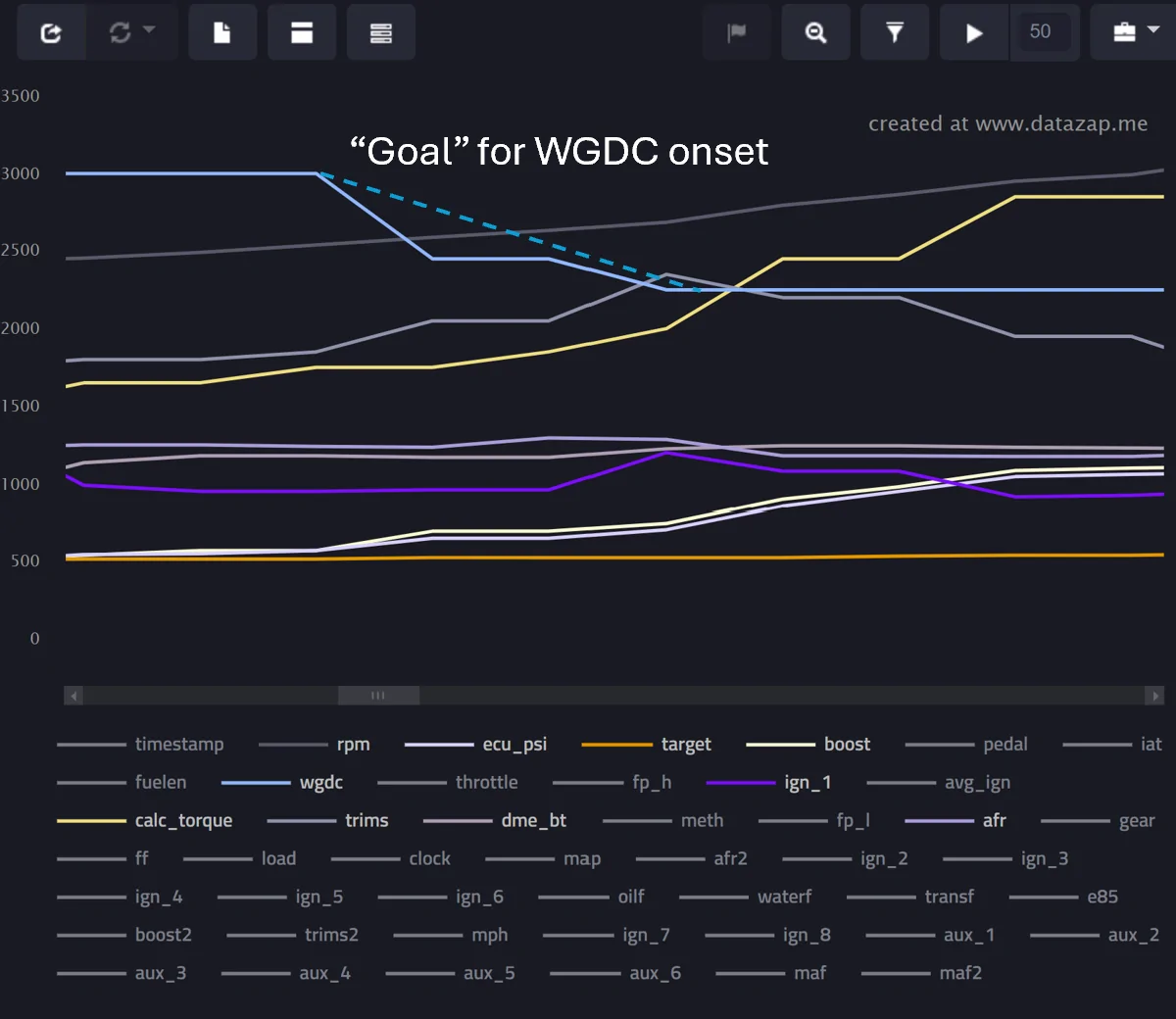
-raise "min gear" variable to ~5 (if still enabled in the firmware) - can you provide any clarity on what the value means? how you've described it seems at odds with the name "min gear".
I don't know if the number means anything tbh, I tested pretty much everything 1-5 and I could see that JB4 would delay WGDC more on spool. Yeah no guarantees it still works but I could see if I can send you my firmware.
Sponsored


nick470

Member
First Name
Nick
Joined
Nov 25, 2025
Threads
0
Messages
15
Reaction score
2
Location
Colorado
Car(s)
2026 Supra MT
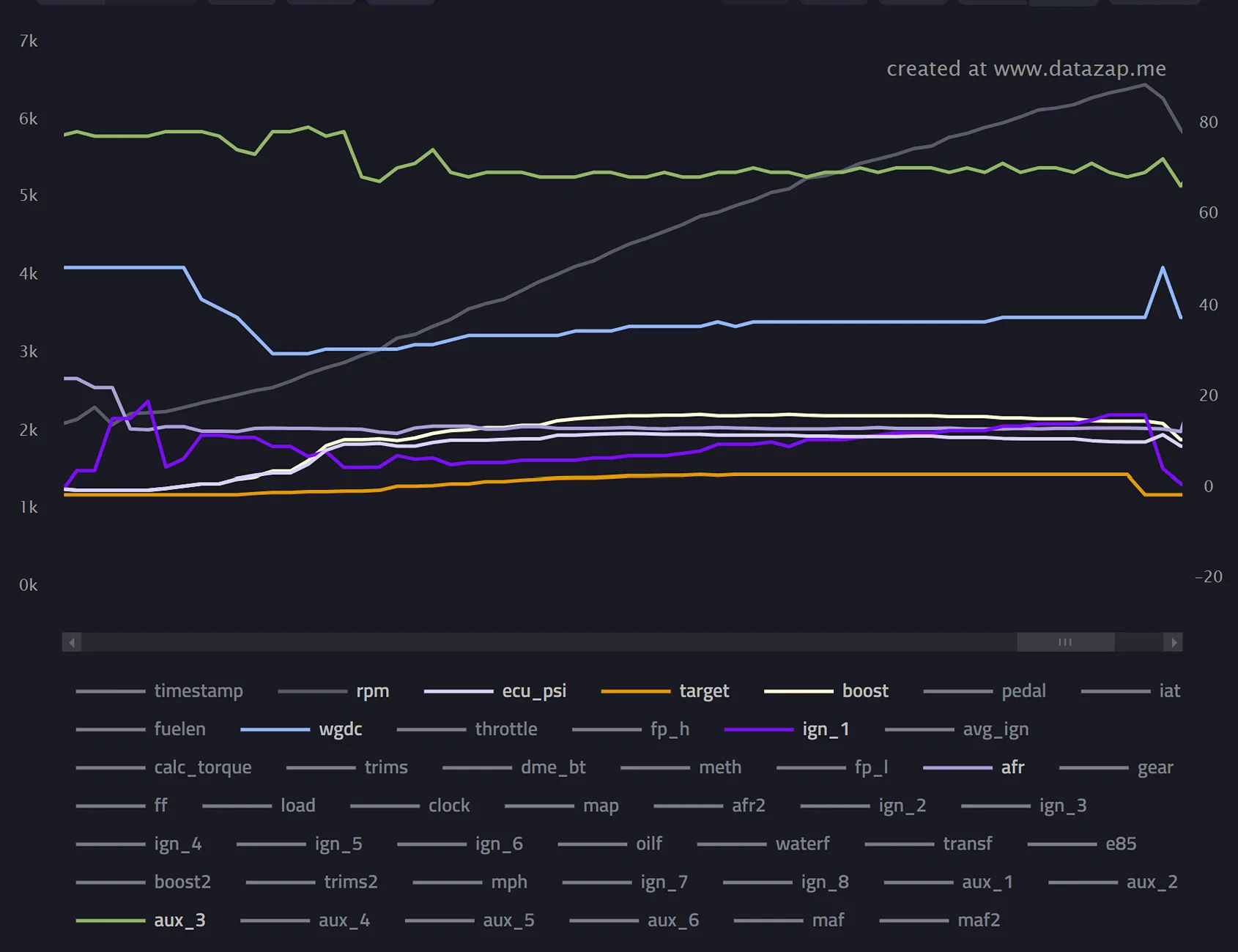
Alright, well I ignored my own sequence for testing this (was short on time and wanted to get some data) so I plugged in my Map 6 targets above, enabled bits 4 and 6, and took a log.

https://datazap.me/u/nick470/map-6-first-pull-e30?log=0&data=1-2-3-4-11-14-18&solo=18&zoom=15-69

Boost Targets
map6_15map6_20map6_25map6_30map6_35map6_40map6_45map6_50map6_55map6_60map6_65map6_70
11.62.22.83.444.54.54.54.54.54

Duty bias starts at 45 and ramps to 50 by 5000rpm
FF: 26
FOL: 62

-one throttle cut at 3000rpm. tapered targets definitely cut out that obnoxious surging and cuts I was getting the other day.
-brief lean spike (16.5:1) immediately followed by trims tapping 49 at the start of the pull, just before the throttle cut. Looks like some work is needed around 2500-3000rpm.
-calc_tq hits 49 at 3200 and 4500rpm. The 3200rpm instance looks to be just part of that lean-trims-throttle cut sequence as it happens the same time as the throttle cut. 4500, maybe just needs a bit of duty bias pulled out?
-ecu_psi is <12 below 4300rpm

After seeing that lean spike, I pulled boost down more at low rpm, took a point out of bias duty <4000rpm, and took another log:

https://datazap.me/u/nick470/map-6-reduced-low-rpm-boost-and-bias-duty?log=0&data=1-2-3-4-13-14

Boost Targets
map6_15map6_20map6_25map6_30map6_35map6_40map6_45map6_50map6_55map6_60map6_65map6_70
000.30.81.82.83.84.44.44.44.43.8

Duty bias is 45 from 1500-3000rpm and then ramps to 50 by 5500rpm
FF: 26
FOL: 62

-NO THROTTLE CUTS!
-still have a lean spike followed by a spike in trims, this time around 2700rpm. AFR hits 15.9 and trims hit 37 (trims aren't concerning at this value, just a localized spike that should be tamed)
-calc_tq hits 49 around 4500-4600rpm
-2.5deg drop in ign_1 around 5400rpm, from 14 to 11.5. This doesn't seem to coincide with anything, so maybe a soft-ish adjustment for knock?
-ecu_psi < 12 until 4000rpm. Looks like theres a region 3000-4000rpm where I'm probably a bit low on duty bias?

I think the boost ramp in the second pull is softer than it needs to be, but I want to dial out that lean spike at the start of the pull. It looks like the JB4's initiation of wastegate control (ie right when it leaves the neutral value of 50) is what triggers it. I'm thinking I need a much more aggressive cut to duty bias at low rpm, or some other mechanism to reduce the slope in FF/WGDC - in a single datapoint, it drops by ~10, and that happens immediately before things get jumpy.

Continuing on the duty bias thinking, calc_tq steadily falls from 4500ish to redline- does it make sense to ramp duty bias up in this region to offset that? "you want as high as possible while keeping calc_tq under 48". Also have low regions in ecu_psi in both of these logs - should I be tuning duty bias to prop up either ecu_psi or calc_tq? The way I'm understanding duty bias, the following seems to be an approach that would sort out all of this:

Duty Bias
152025303540455055606570
01225375050505254565860

basically, ramp duty bias in from 0. At the ~2500rpm point where WGDC is kicking in, this should cut the WGDC jump in half by reducing the value in that cell from 50 to 25? Am I thinking about this correctly? The fact that JB4 can command a reduction in WGDC vs the stock mapping, and there's a hidden curve that these factors are scaling is confusing me a bit. I basically just want to extend that initial step by a few data points, without opening the wastegate more than the ECU wants at that time:
1766097451585-22.webp


EDIT:

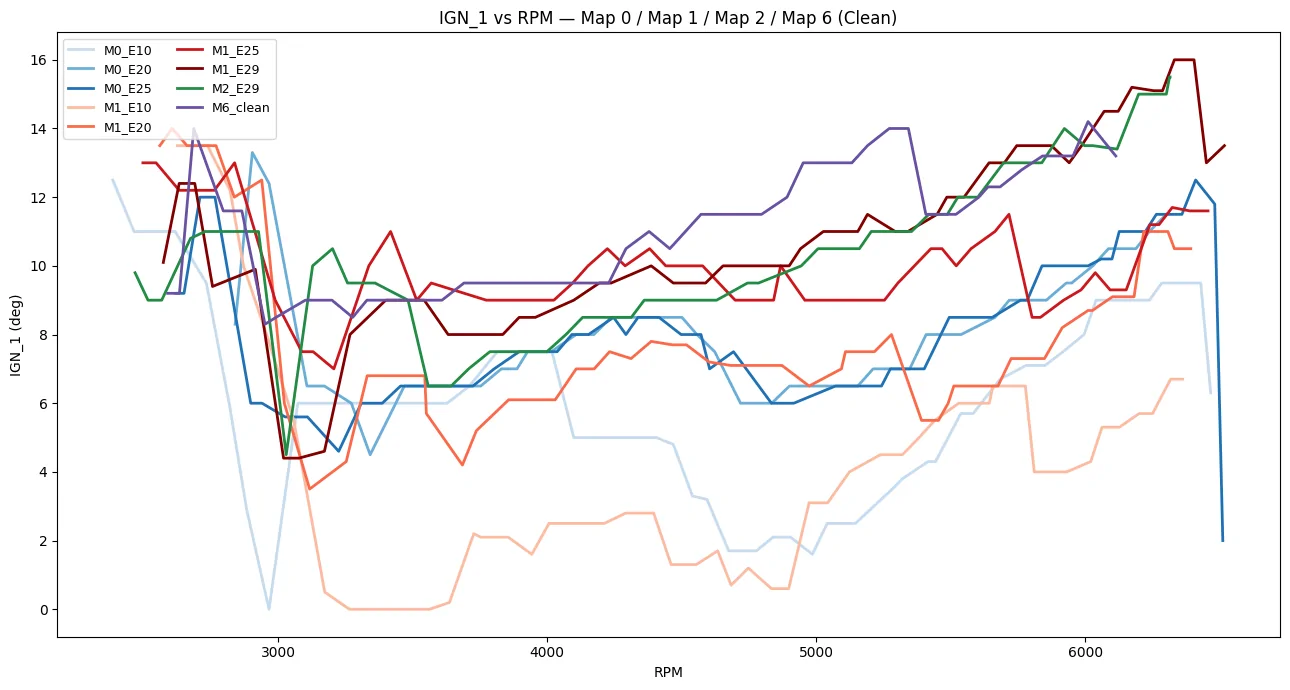
I looked a bit more into that timing cut in the second log. Stuck it on the "ensemble" graph with all my different map logs and ethanol contents:
1766102377118-63.webp

the timing "cut" just brought ign_1 right in line with my E29 Map 1 and 2 logs. It was deviating quite a bit higher than those from around 4300-5300rpm, and then jumped back in line. Not sure how to interpret that, it would be interesting to see the complete logic set for how the car sets timing. Stock boost levels had the car converging on one general line ("swoopy" darker blue) when it had sufficient octane, adding boost pushed timing higher. It almost seems like the ECU tried to get really aggressive with timing, probably pushed just a little too far, and then reacted by bringing it down to a lower target curve that aligned with what it wanted to run Map 1 and 2 on (with ~E30). From a timing stability standpoint, it seems like changing the JB4 target/offset in this region confuses the ECU - it's perceiving it as boost falling off, and it leans on ignition advance to either try and catch it, or to capitalize on it?
 
Last edited:

Turbro

Well-Known Member
Joined
Jun 6, 2018
Threads
4
Messages
556
Reaction score
911
Location
Somewhere USA
Car(s)
24 Strat 3.0 MT, 94 Supra TT 6Spd
I’ve been rocking v27 I think on map 1 this year. Any updates I should perform? Fixes or changes that would assist a ‘24 MT?
 

nick470

Member
First Name
Nick
Joined
Nov 25, 2025
Threads
0
Messages
15
Reaction score
2
Location
Colorado
Car(s)
2026 Supra MT
Hope everyone is having a great holiday and spending some time with family.

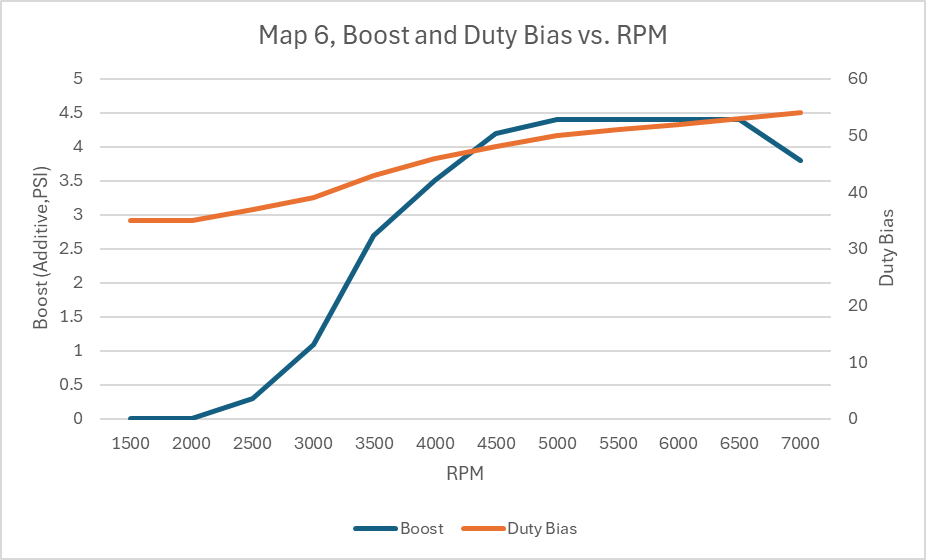
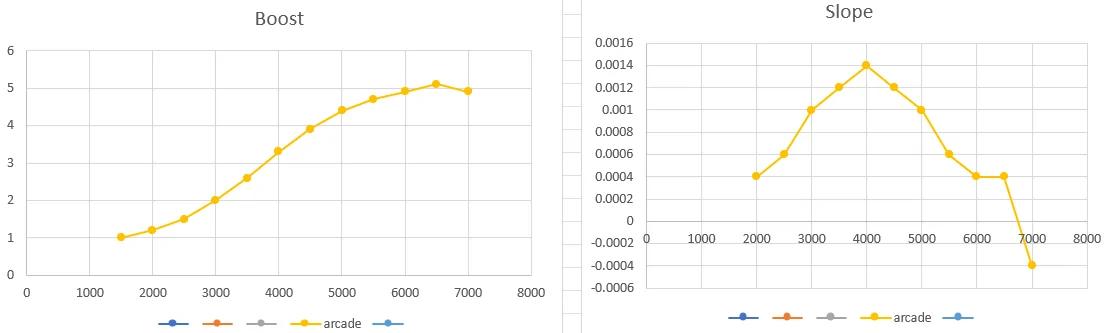
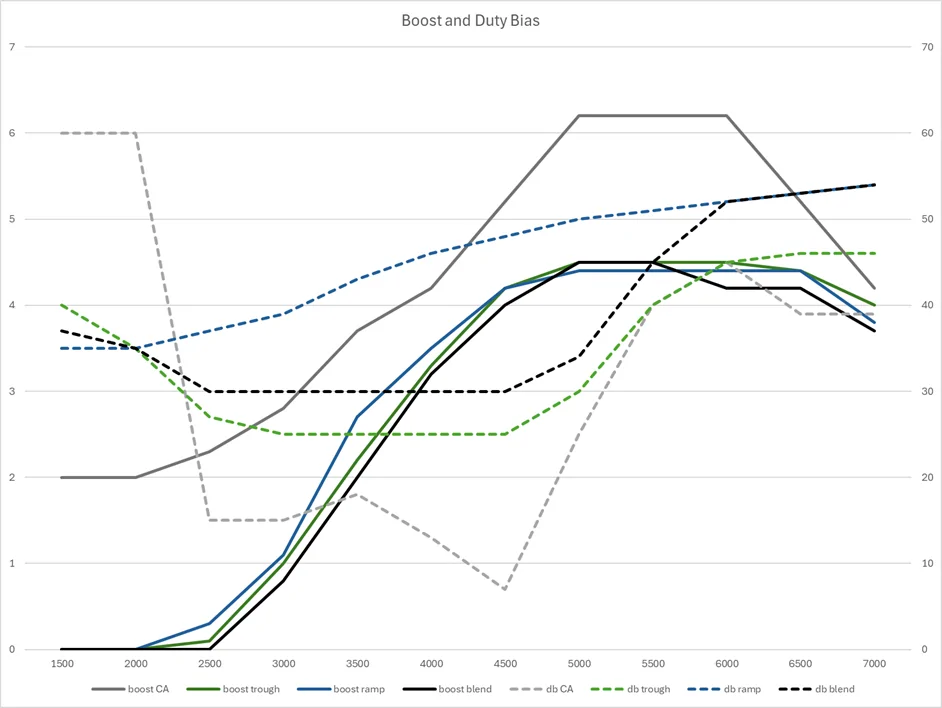
I've been steadily tweaking Map 6 and fed the car a little bit more corn. Now at ~E38. I had a hunch that the ECU was showing sensitivity to not only large JB4 offsets or sudden inputs in changes, but also to first and second derivative changes. This was showing up in spool up region AFR, trims, ign, etc. So I got pretty aggressive about giving everything a nice transition and minimizing sharp inflection points, and dropping boost and bias duty a fair bit at low RPM. Admittedly this made it hard to identify what's doing the heavy lifting - rounding out curves or just bringing average values down - but the car seems to like it regardless.

1500​
2000​
2500​
3000​
3500​
4000​
4500​
5000​
5500​
6000​
6500​
7000​
Boost
0​
0​
0.3​
1.1​
2.7​
3.5​
4.2​
4.4​
4.4​
4.4​
4.4​
3.8​
Duty Bias
35​
35​
37​
39​
43​
46​
48​
50​
51​
52​
53​
54​

1766607113328-ln.png

This is probably softer than I need to be at low RPM, but I was really eager to minimize any spikey behavior in the spool up region. Here's the log:

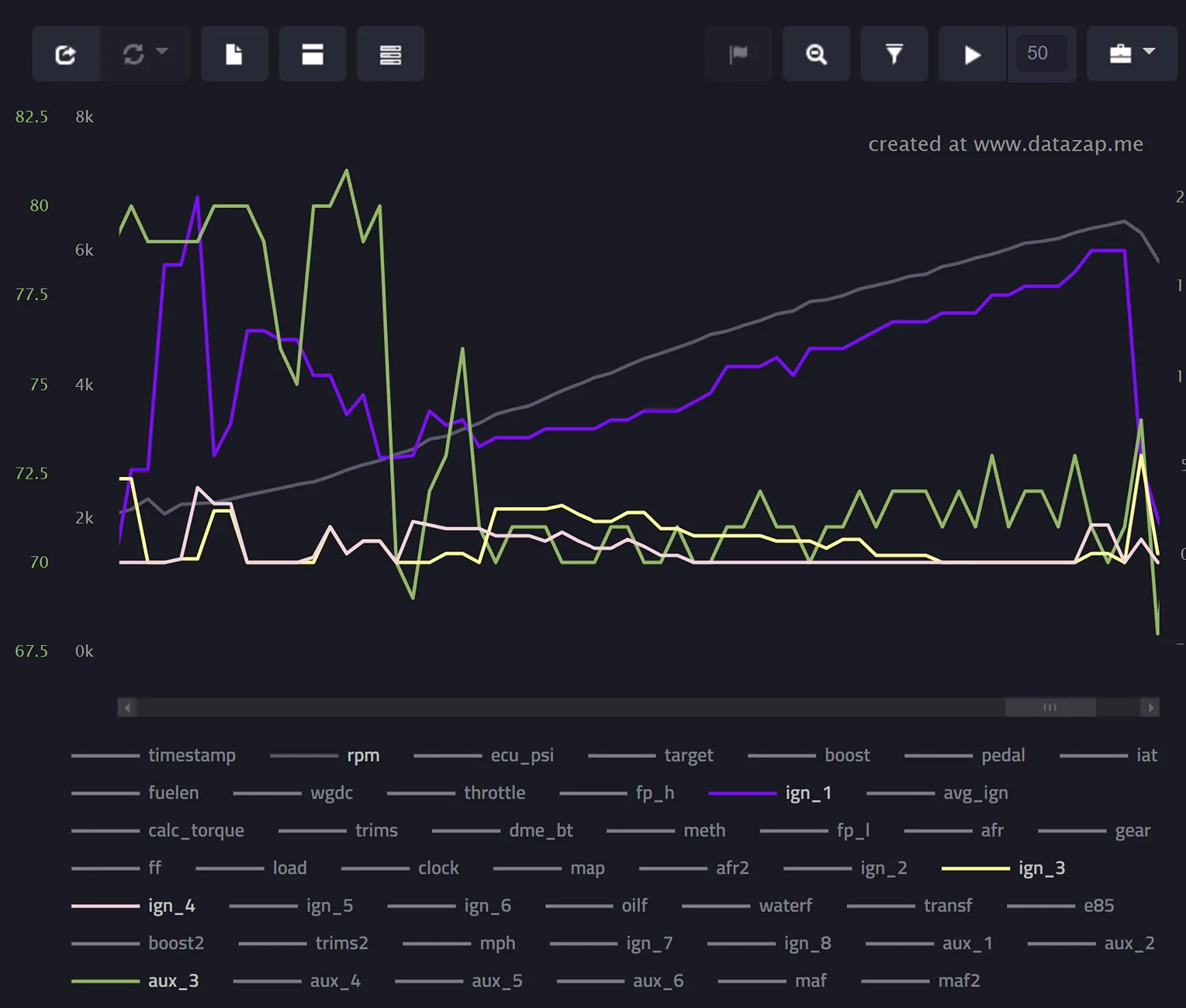
Log: https://datazap.me/u/nick470/map-6-e38?log=0&data=1-4-8-11-18-41&zoom=599-662

I still think there's some ECU reaction to the JB4 "coming on" at the start of the spool, this shows up at some oscillating behavior in aux_3 (actual wastegate position/duty) that is not in wgdc/ff. Shouldn't be a big surprise that throwing something "extra" at a system that has finely tuned closed loop control systems is going to make them struggle a bit to reach target quickly without oscillation.

1766607753907-uq.webp


It shows up as a little bump in ign as well. Ignition corrections steadily decay after this, so it looks like those are just a response to this wastegate behavior and not a knock response through the midrange of the pull. My thinking is that pulling down duty bias in this region even more and shaping the ramp to keep a smooth transition should continue to soften the initial hit of the JB4. With a little luck this might also let me give it a bit of boost back at low RPM, it would be nice to have another pound of boost or so from 3-5k and I know I'm particularly soft in this region with the current settings.

Ignition response (only affected cylinders shown)
1766609500555-g8.webp

Interesting little observation from this view - looks like the "troughs" in the wastegate oscillation are the trigger that kicks off the corrections on ign_3 and 4.

I'd love any thoughts you guys have on the current tune/log, drivetrain limits, etc.
 

i3igpete

Well-Known Member
Joined
May 16, 2022
Threads
44
Messages
1,254
Reaction score
1,485
Location
Chicago
Car(s)
2023 3.0L 8AT
I've been steadily tweaking Map 6 and fed the car a little bit more corn. Now at ~E38. I had a hunch that the ECU was showing sensitivity to not only large JB4 offsets or sudden inputs in changes, but also to first and second derivative changes. This was showing up in spool up region AFR, trims, ign, etc. So I got pretty aggressive about giving everything a nice transition and minimizing sharp inflection points, and dropping boost and bias duty a fair bit at low RPM.
1766607113328-ln.png
I came to a similar conclusion a few months back, the huge delta (offset? Error?) caused by absolute targets can wreak havoc if the dme_bt has pull to pull (and gear to gear) variation. I ended up with something like +1.5 on the low end, it seemed happier if the dme was being lied to less during the spool transients

1000015222.webp
 
Last edited:

nick470

Member
First Name
Nick
Joined
Nov 25, 2025
Threads
0
Messages
15
Reaction score
2
Location
Colorado
Car(s)
2026 Supra MT
Got a lot more data, so I'm going to have to break this up into a couple posts in this thread.

First, some rambling commentary on control systems that I had initially typed out in the middle of all my log review observations, but figured would make more sense (and be easier to skip) if I just stuck it up front. If this is uninteresting or uninformative, just jump to my next post.
_______________________________________

It’s worth pausing to think about what we can tell from how control systems respond. A basic open loop system simply puts a “blind” input into a system and whatever comes out the other end is what you get. Tuning a system like this is just dialing that input to get the output closer to target – in effect, the person adjusting that input value turns the system into a closed loop system. It’s generally not practical to have a person adjusting the inputs 100% of the time that system is operating. A closed loop system takes an initial input value and applies it, but then observes (through a sensor or whatnot) the actual output. Based on the error between actual output vs target output, it can then adjust the input to try and reach target. Just about everything in a modern engine operates on a closed loop system to some extent.

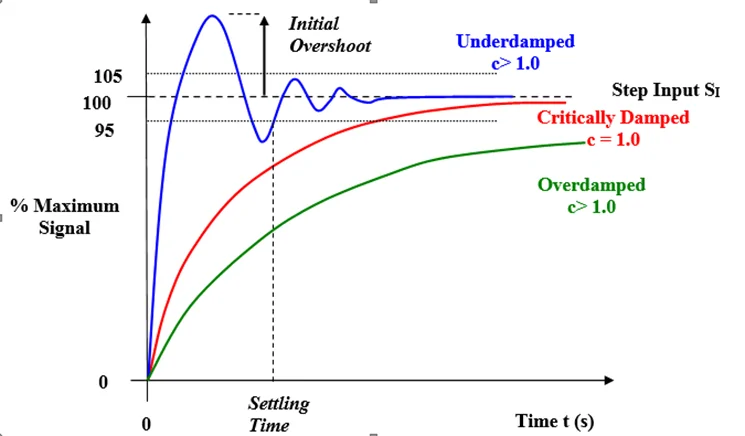
What gets a little more complicated is how it goes about correcting the input value, which is how we get PID systems. Think of it like a spring. You have the resting/neutral position (target), and you can compress or extend that spring (actual). Once released, the spring will snap back towards its neutral position – this is basically the “P” (Proportional) in PID. But the spring won’t hit its neutral position and stop there, it will overshoot and oscillate for a while. If it weren’t for friction, mass, wind resistance, etc – it would just oscillate forever. Obviously undesirable. So the next term you add in is “D” (Derivative). This is basically a control on the rate of change of the error. For the spring analogy, it’s the damper. The damper’s resistive force is proportional to the velocity. If things are moving slow, the damper isn’t doing much, but when things move fast the damper is helping to push against it to control overshoot.

If you have very little damping (underdamped), you’ll hit target quickly but oscillate for a long time. If you’re overdamped, it’ll take forever to reach your target. Depending on the needs of the system (ie is it more important to hit target quickly or minimize overshoot), either one could be preferred. Generally, things err on the side of slightly underdamped to get to target quickly and just keep the magnitude of oscillations in an acceptable window.

The “I” (Integral) term doesn’t have much of a spring/damper analogy, but you can think of it like long term trims. This term helps to adjust for persistent “area between the target and actual curves” error.

1767046958860-mi.webp

Really that was just a long-winded way to get to something that applies here. We’ve added things to the system that the factory control systems weren’t tuned around, and now when we give them too much initial error, their “slightly underdamped” initial state can become problematic. Oscillations that were previously in a nice and tidy window of acceptability are now oscillating with an unacceptable magnitude. These control systems are already at work when the car is stock – manipulating the wastegate, modulating the throttle, adjusting fuel and timing – and they are especially active whenever things are changing (ie spool, sudden throttle changes, etc). If we stick MORE error onto them at this point with the JB4, we’ve basically just pulled the spring back harder and it is going to snap back that much harder. We want to let the control systems get a handle on the changes that are already happening before we tack on more error; this will help keep the peak magnitude of the total system error in a window where the control system can manage it effectively. And we can do this even better by gently ramping our inputs, so the control system can stay up to speed on our inputs instead of dealing with the maximum value all at once.

Remember how a closed loop system starts with an initial value? FF/WGDC/duty bias help to shift that value by applying bias to the wastegate signal. One of the main goals in tuning these is to minimize error in the wastegate control system – when we apply JB4 boost targets, we’re directly manipulating the “actual” value that gets sent back. Our stock “initial” values are now going to result in an initial error much higher than stock. FF/WGDC/duty bias attempt to zero this out. This is a double edged sword though, by manipulating wastegate we impact turbo operation and drive additional error in other systems (fuel, ignition, etc). It’s a big balancing act to try and keep everything within reasonable bounds for the factory control systems to keep up.

When we see larger magnitudes in oscillation, we know we have larger initial system error; the spring is pulled back harder. This shows up all the time in logs.
 

nick470

Member
First Name
Nick
Joined
Nov 25, 2025
Threads
0
Messages
15
Reaction score
2
Location
Colorado
Car(s)
2026 Supra MT
And now for some actual log review.

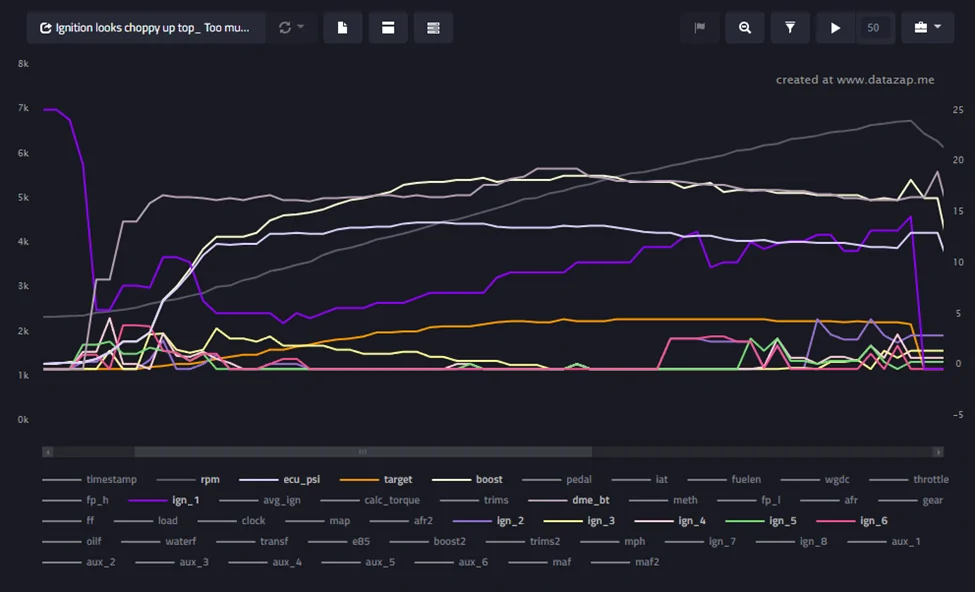
The car seemed reasonably happy with the super rounded duty bias from my previous post, but it was still showing some oscillation and general “control system unhappiness” at the start of the pull, and calc_tq pushing into the 48+ region in the midrange. I made some more small adjustments and took more logs but didn’t come to any groundbreaking revelations. Noticed that if I started to push closer to 5psi, ignition corrections would perk up a fair bit starting around 5600rpm.

https://datazap.me/u/nick470/map-6-choppy-ign-top?log=0&data=1-2-3-4-11-15-25-26-27-28-29&zoom=12-79

1767047232387-om.webp


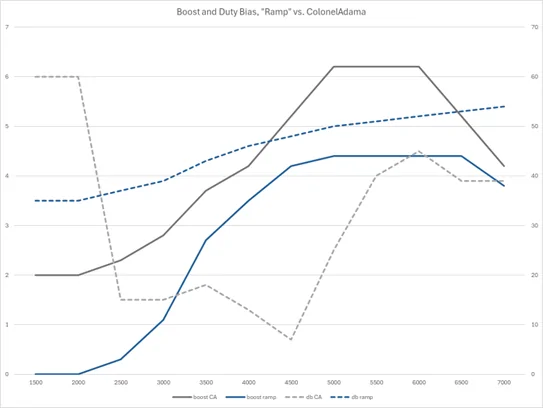
I took a look at a log that coloneladama posted in this thread of his own car, and compared the approach to my own.

1767047241075-o9.webp


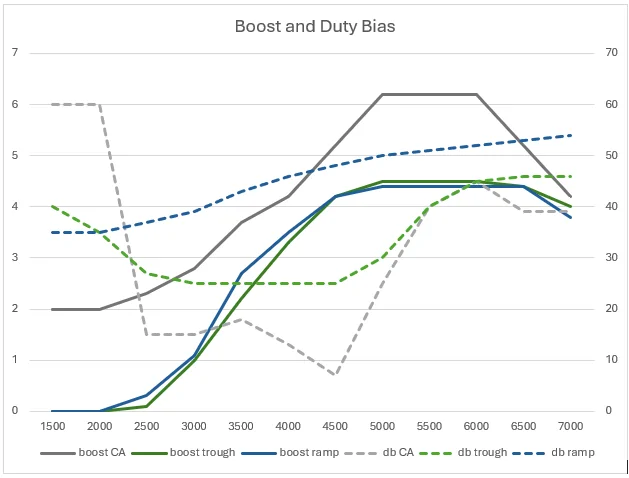
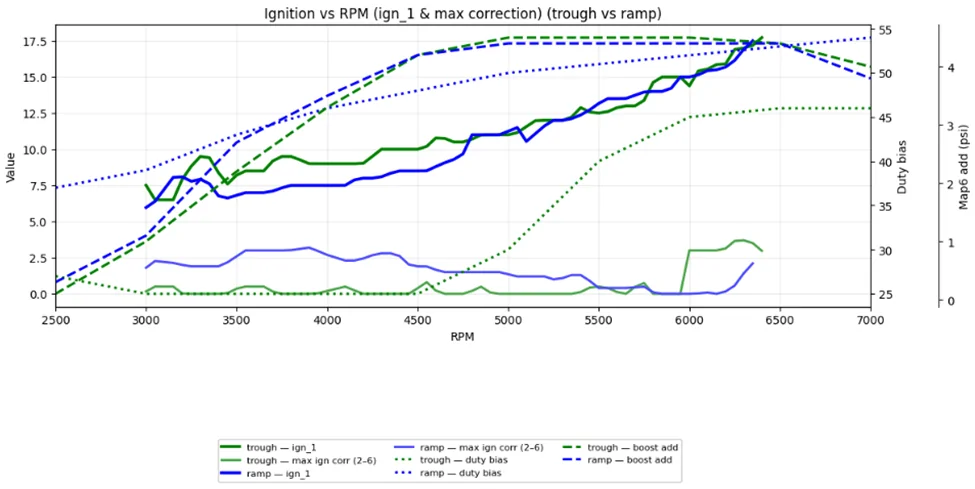
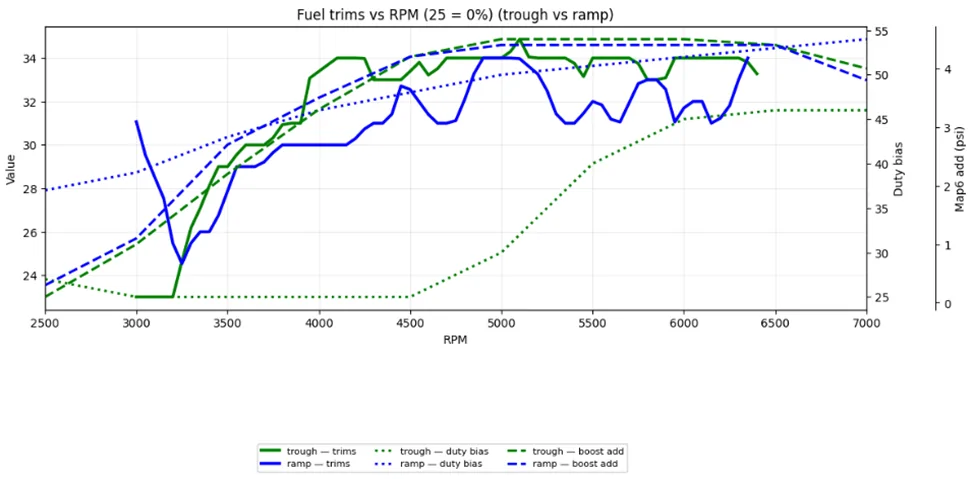
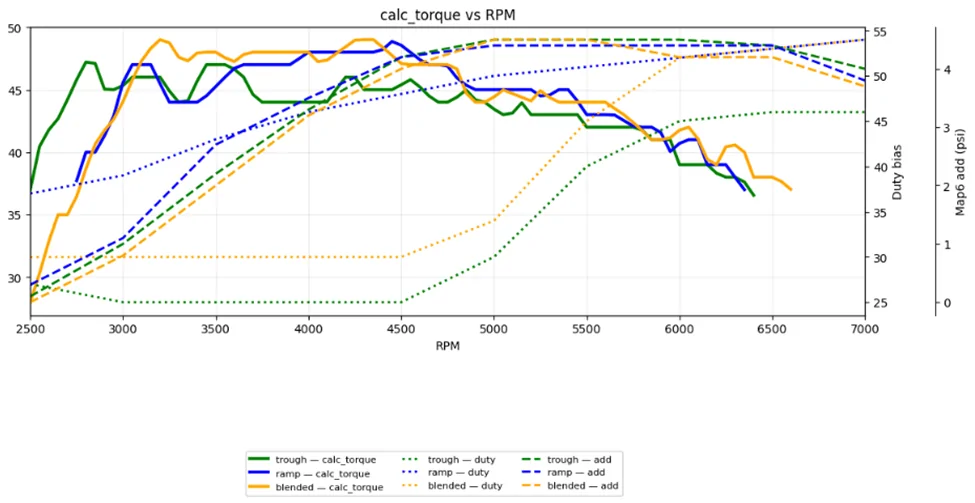
Some differences are to be expected between his tables and an ideal set of tables for my car – I’m running a stock downpipe and my car lives above 5000’, but I would assume that the overall shape of the curves should be similar. That’s true for boost, but there’s a pretty striking difference in our duty bias approaches. FF is a fair bit different between the two which should handle the “macro” scaling to account for the downpipe. What I found interesting is that I was feeding the car more duty bias early, starting the ramp upwards at 2500rpm, and generally living ~30 points higher through the midrange. I put together a “trough” duty bias table sitting roughly between the two.

1767047295645-ns.webp


https://datazap.me/u/nick470/map-6-...b-midrange-trough?log=0&data=1-4&zoom=150-221

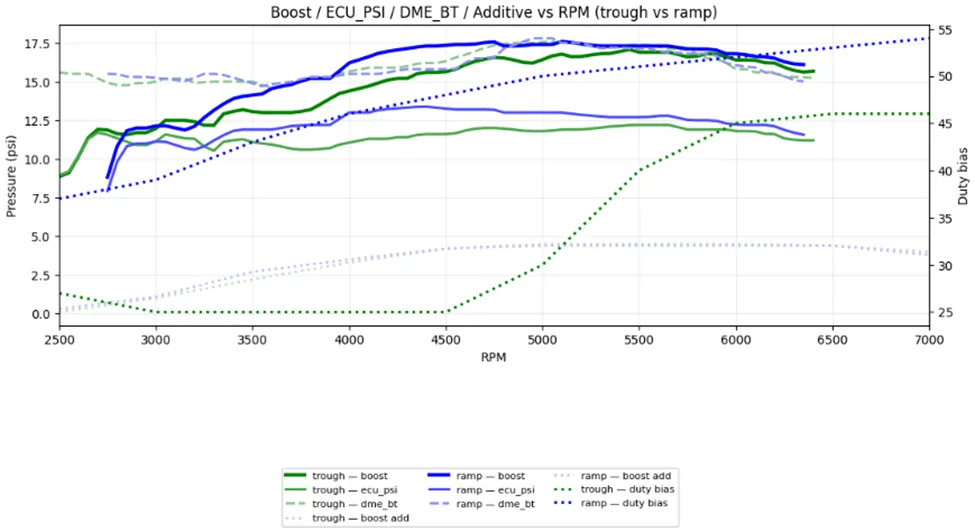
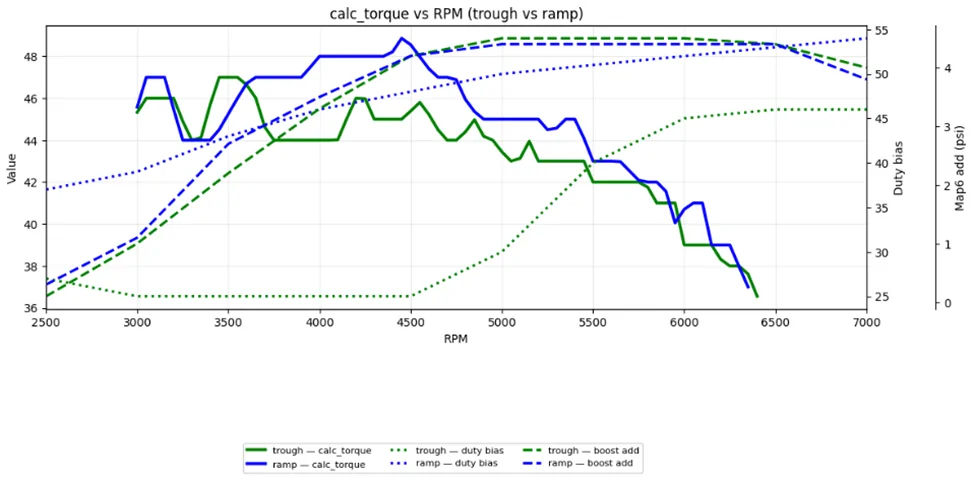
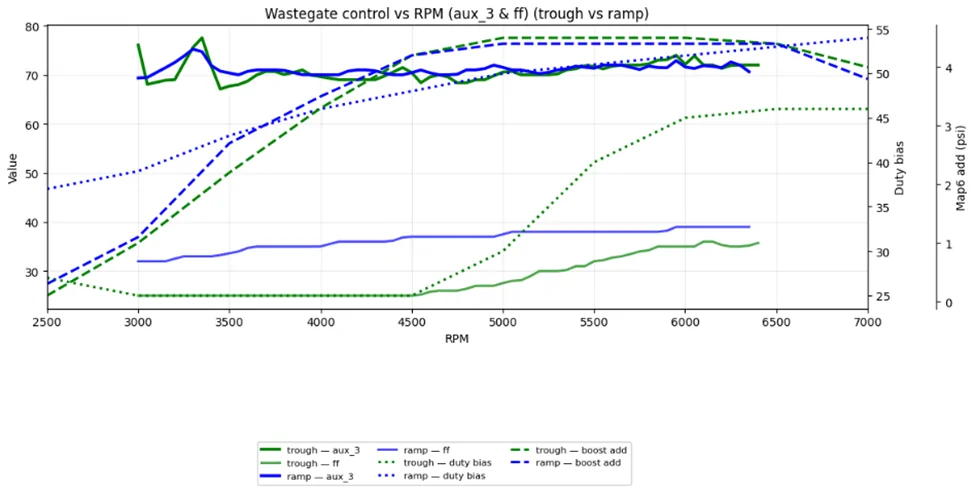
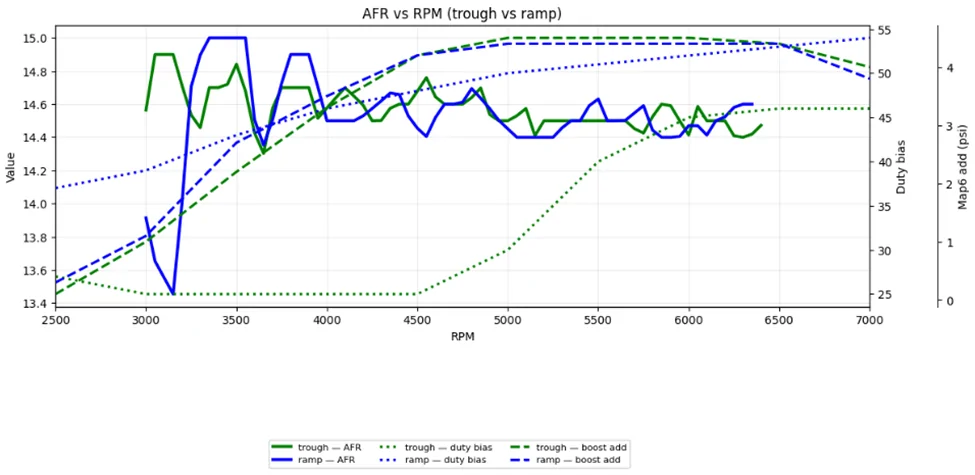
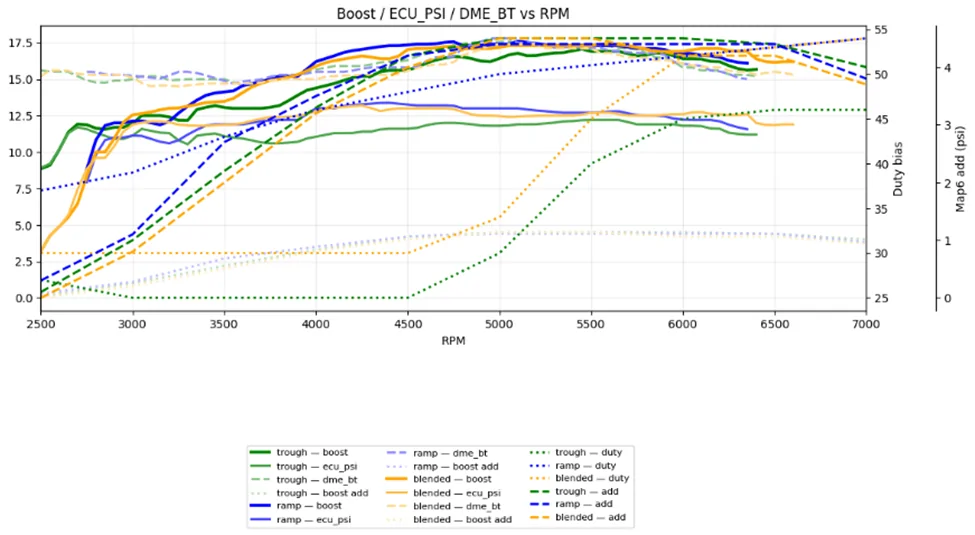
This gave a nice basis for comparison with some relatively large magnitude changes in duty bias through most of the curve. I probably should have set boost to be identical between the two, but they’re very close so its still largely an apples to apples comparison. IAT in both logs is mid 70s and coolant temp ~220, so temperature factors shouldn’t be driving large difference in the ECU’s approach to boost targets and ignition.

1767047333308-xr.webp


Right off the bat, we can see that boost and ecu_psi moved in tandem somewhat proportionally to the change in duty bias, while dme_bt held much tighter between the logs.

1767047363050-dc.webp


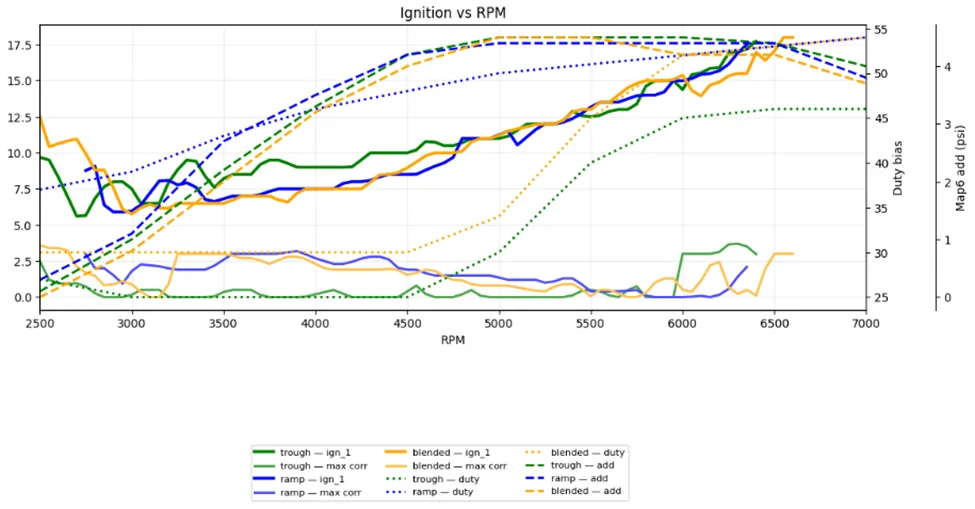
In this graph, “max ign corr” is the maximum value in ign_2 through 6. Somewhat unsurprisingly, corrections are higher and nominal/ign_1 is lower with the higher boost. At the top end, where duty bias gets closer between the two logs, we can see boost and ignition values converge. If we take the ~4000rpm datapoint, a 21 point change in duty bias resulted in about a 2psi shift in boost and 2degree shift in timing. All else equal at this point in the analysis, the “trough” approach looks better below 5500rpm, and probably a slight nod to the “ramp” at 6000+. Something to note, and I’m leaning heavily on ColonelAdama’s guidance here, ecu_psi in the “trough” log pretty much stays below 12 for the whole pull, vs a target range of 12-16psi. In contrast, the “ramp” log keeps ecu_psi around 12-13.5psi for most of the pull.

1767047371985-v7.webp


Moving on to calc_tq, the ramp log sits at 48+ in the 4000-4500rpm range. The trough log is a fair bit lower throughout the midrange, sitting at 44-46 for the same range after hitting 48 at a single datapoint at 2800rpm.

By this point, it’s looking like ideal duty bias in the midrange sits between the two logs based on ecu_psi and calc_tq, with a nod to the “trough” approach for the cleaner timing. At the top end, the “ramp” looks to win pretty handily across all parameters.

1767047381017-pb.webp


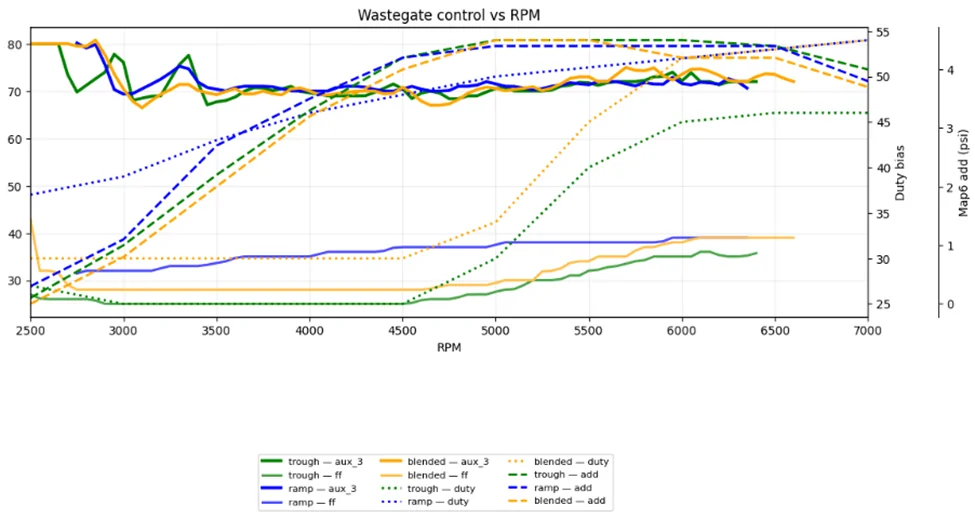
Wastegate control doesn’t really show much besides the obvious difference in FF. Aux_3 (which I believe is “true” wastegate position/duty after both ECU and JB4 influence) is more or less the same across both, with perhaps a bit more noise in the “trough” log, and larger magnitudes of oscillation.

1767047422573-li.webp


1767047437927-ka.webp


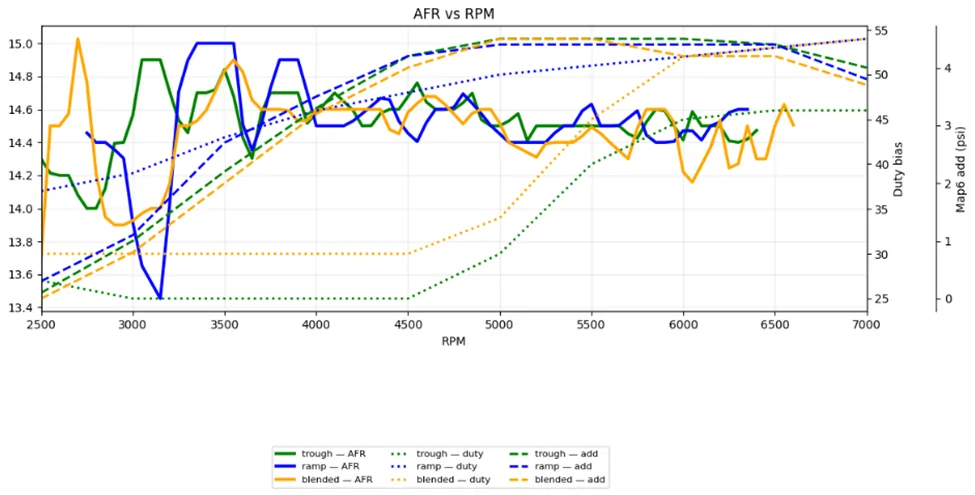
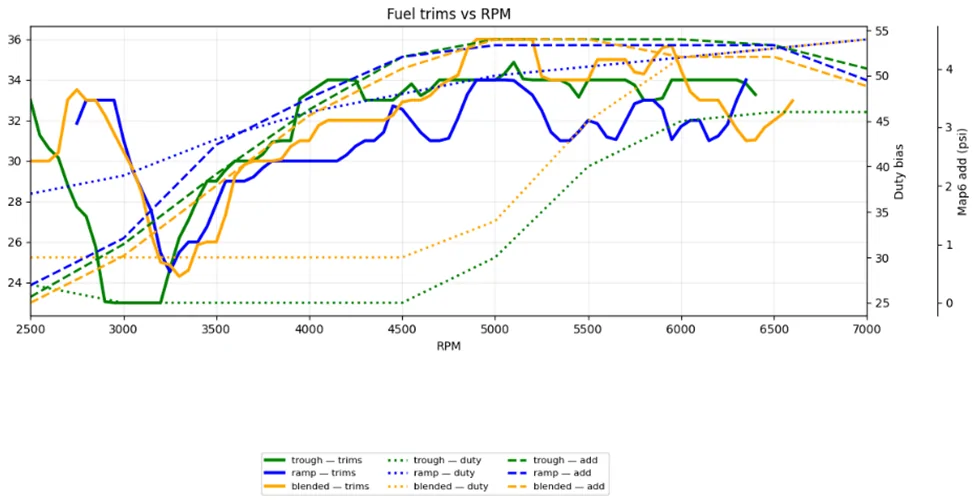
AFR and Trims demonstrate that last point I made while I was rambling about control systems. The lower duty bias reduced magnitude of oscillation quite substantially. Trims lag AFR – as they are the system response to AFR error. Based on the location in the largest “peak” on both, that can be as much as 1500rpm. AFR is a better indicator of where in the tune things are off, and trims are really just an indicator how much corrective headroom you have.

The ”trough” map has less oscillation; ie it’s playing nicer with the factory control system. Additionally, trims are higher for the same AFR, despite lower boost. The car is most likely making more torque throughout the midrange with the “trough” map.
 

nick470

Member
First Name
Nick
Joined
Nov 25, 2025
Threads
0
Messages
15
Reaction score
2
Location
Colorado
Car(s)
2026 Supra MT
After comparing these two logs, I decided to mix and match the best parts of each and try the result. I then made some secondary adjustments, like raising the trough a bit to try and bring ecu_psi and calc_tq a little closer to target. I also pulled boost targets down slightly on either side of the peak to help control the early and late pull ignition noise.


1767047527881-1l.webp


https://datazap.me/u/nick470/new-map-6-first-pull?log=0&data=1-2-4-15&zoom=57-114

1767047554831-79.webp


Interesting response here – the blend map’s duty bias is much closer to “trough” than “ramp”, AND boost target is lower than both, but both boost and ecu_psi landed much closer to the “ramp”. I read this as changes at the lower end of the range in duty bias produce an oversized response when compared to changes in the middle. This would also correlate with my experience when I first started deviating from the canned 50’s all the way across the table – it seemed like changes of 2, 5, etc weren’t really doing much.

1767047582220-fu.webp


Not what I expected here, but it tracks with boost landing closer to the ramp log. Somehow I got the worst of both worlds here, corrections on both ends and the lower ign_1 curve below 5000.


1767047603058-y4.webp


Less early oscillation here than “ramp” and “trough”, but it starts riding the upper limits quicker. The next graph explains it:

1767047634570-dm.webp


Wastegate control settles faster and with shallower oscillations on the blended map. The slightly higher duty bias is clearly closer to the correct initial value, and the control system is not having to fight as hard to hit target. Unclear exactly which direction it wants to go, but based on calc_tq already touching 49 twice in this log, I think a small reduction is probably the move.

1767047679418-ff.webp

1767047716144-be.webp


Not a ton of takeaways from AFR – all three are pretty noisy and oscillatory <4000rpm. Overall, I’d say that “blended” probably sits right in between the other two, but it does appear to settle a little quicker than them as well. At the top end, there’s a lot more noise. This is the same area where we see ignition corrections perk up a bit. Trim behavior is smoother in “blended” from ~3750 to 5000rpm. Above that, “trough” takes the cake for it’s stability. We can probably take the calmer trims in this region to mean that the ECU is happier with the AFR activity in the region immediately preceding it.

Log feedback is welcome and greatly appreciated!
 

nick470

Member
First Name
Nick
Joined
Nov 25, 2025
Threads
0
Messages
15
Reaction score
2
Location
Colorado
Car(s)
2026 Supra MT
Looking at logs with controlled pulls from 2500-6500rpm is great for evaluating behavior under max load, but it also misses transient behavior. Since we only have a few knobs to turn with the JB4, issues in transient behavior naturally have to be addressed by adjusting the same things that affect our max load behavior. We spend a lot of time tuning for the car to spool at 2500-3500rpm, softening curves to ramp things in gently and keep the system stable, but what about when that spooling event is happening in a table region that we didn’t design for spool?

https://datazap.me/u/nick470/log-1766878439?log=0&data=1-4-5-11-14-18&solo=5-18&zoom=137-187

1767047957127-pp.webp


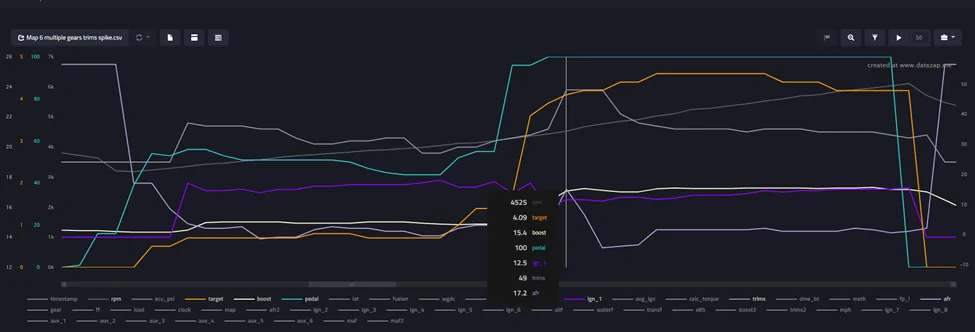
Yikes. It’s brief, but trims peg at 49 and AFR hits 17.2 at 15 pounds of boost. Here, I’m sitting at ~50% throttle and quickly jump to 100% at 4200rpm. Wastegate (aux_3) spikes to its max(?) value of 80, and FF/wgdc are not the driver; in fact those even drop from 30 to 26 during the transition.

I’m not aware of any settings that let us manipulate how the JB4 ramps in it’s boost target based on pedal input. There’s a little bit of latency between when the pedal moves and when the boost target starts to change, but it still comes on hard enough that fuel can’t keep up. With JB4’s wastegate control, it should be possible to pull back on the wastegate to slow spool down a little bit in a situation like this, or add more delay to the boost target, or simply set a maximum rate of change for the boost target, I’m just not sure if that’s something I have access to adjust.

I tried reducing duty bias a bit and increased FOL to 65 (larger value DOES mean higher fuel pressure, right?) but still got spikes in similar situations, so I don’t really think that’s the correct knob to turn to address this.

I still have bits 4 and 6 enabled, and I’m wondering if those could be an influence on this.

A few final questions:

  • I noticed in others’ logs that boost rapidly rises to dme_bt and then steadily climbs above it. In my logs, I’m seeing the values converge. I also ran a Map 0 log to check stock behavior – compared to stock, my Map 6’s +4.XXpsi request works out to around +2psi and +2deg timing. Manipulating duty bias moves BOTH ecu_psi and boost. Should I be trying to bring ecu_psi closer to its baseline map 0 value in the same ambient conditions? Should I just try to push it to 1-2psi below dme_bt? Or does it just land wherever it lands upon getting other parameters sorted?
  • Can anyone provide a good high elevation log that I can reference, or comment on changes in the stock ECU behavior that are apparent at lower air density?
  • What have people seen for stock turbo limits at 5000'+ elevation? Sea level recommendations aren't totally relevant due to pressure ratios, my turbo will run out of gas and be at risk of overspinning at a lower nominal boost value than a sea level car.
 

razorlab

Well-Known Member
First Name
Bryan
Joined
Oct 2, 2021
Threads
29
Messages
8,568
Reaction score
16,797
Location
Hudson Valley, NY
Car(s)
Not a Corvette.
@nick470

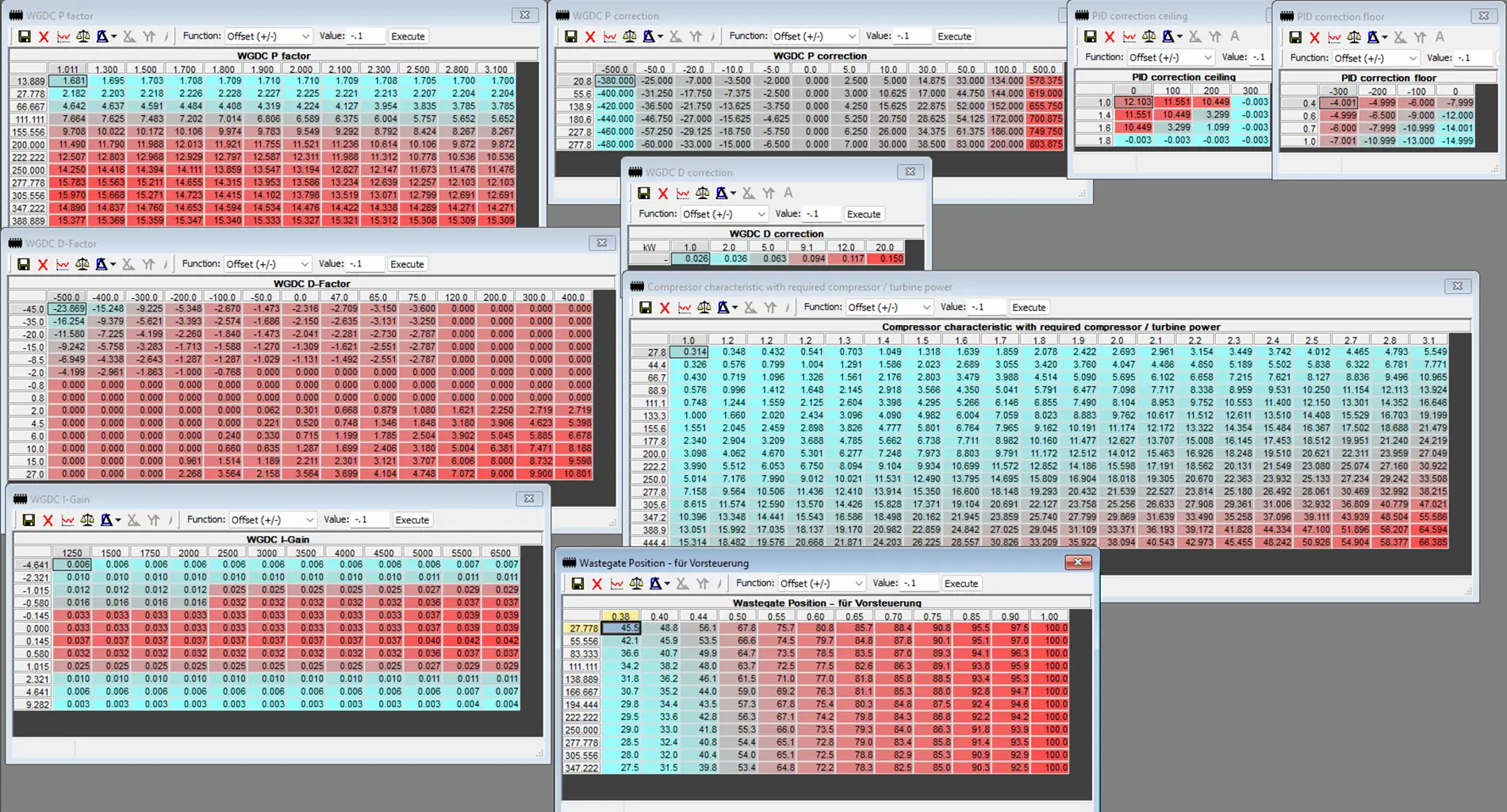
Here are the OEM PID tables for reference so you aren't flying blind. OEM boost control also runs off a compressor energy table and a base WGDC lookup. PID changes the base compressor energy +/- to demand more/less WGDC depending how over/under boost target everything is.

There are also floor/ceilings for the PID controls. Also a bunch of turbine modeling and other inputs but these are most of the PID control system tables.

Also, the simplified explanations of PID:

P - Real time WGDC correction
I - Longer term WGDC correction (usually happens mid rpm/gear during WOT)
D - Dampening/softening of everything (more = smoothes out corrections, less = lightning bolt corrections)


Screenshot 2025-12-29 at 6.40.53 PM.webp
 

nick470

Member
First Name
Nick
Joined
Nov 25, 2025
Threads
0
Messages
15
Reaction score
2
Location
Colorado
Car(s)
2026 Supra MT
@nick470

Here are the OEM PID tables for reference so you aren't flying blind. OEM boost control also runs off a compressor energy table and a base WGDC lookup. PID changes the base compressor energy +/- to demand more/less WGDC depending how over/under boost target everything is.

There are also floor/ceilings for the PID controls. Also a bunch of turbine modeling and other inputs but these are most of the PID control system tables.

Also, the simplified explanations of PID:

P - Real time WGDC correction
I - Longer term WGDC correction (usually happens mid rpm/gear during WOT)
D - Dampening/softening of everything (more = smoothes out corrections, less = lightning bolt corrections)
Thanks for the tables, this is helpful. Do you have the axis units so I know how to interpret them?
 

razorlab

Well-Known Member
First Name
Bryan
Joined
Oct 2, 2021
Threads
29
Messages
8,568
Reaction score
16,797
Location
Hudson Valley, NY
Car(s)
Not a Corvette.
Thanks for the tables, this is helpful. Do you have the axis units so I know how to interpret them?
WGDC P Factor:
Y = Turbine MAF target (After Correction) in grams/sec
X = Boost setpoint
This is a limit table.

WGDC P Correction:
Y = MAF Pre Turbine in grams/sec
X = Boost Deviation in hPa

WGDC D Factor:
Y = Boost Deviation in hPa
X = Boost Target Deviation in hPa

WGDC D Correction:
Y = Turbine Output in kW
Z = Percentage Factor

WGDC I-Gain:
Y = Boost Target Deviation in hPa
X = Engine Speed

Compressor characteristic:
Y = Turbine MAF target (After Correction) in grams/sec
X = Boost setpoint

Wastegate Position:
Y = MAF Pre Turbine in grams/sec
X = Distribution Factor (basically how much the WGA is open/closed)

PID Correction Ceiling:
Y = Target Pressure Ratio
X = Boost Target Deviation in hPa

PID Correction Floor:
Y = Target Pressure Ratio
X = Boost Target Deviation in hPa
 

Turbro

Well-Known Member
Joined
Jun 6, 2018
Threads
4
Messages
556
Reaction score
911
Location
Somewhere USA
Car(s)
24 Strat 3.0 MT, 94 Supra TT 6Spd
duty_15duty_20duty_25duty_30duty_35duty_40duty_45duty_50duty_55duty_60duty_65duty_70
303030323434344664646668
Yeah, try it with FF=16, PID gain=15, these duty bias

Probably map 1 to start. And of course needs to be on Firmware V24

Not sure on the altitude, I figure the car will mostly adapt but we'll see how the log looks
Okay so my roads are snow covered, but just got the JB4 installed and setup today. Im a catless AA car with arma intake. Im on firmware 158/26//5 per the app.

Ive set my fuel duty to the above numbers, FF to 16 and PID to 15. I also turned Auto Boost to 0 as per another post for MT cars (but not sure if that is even released yet). Im on map 1 and will go log next time I can.

I was curious if thats all we need to change? No other settings to worry about for now? I have the fuel pressure plugs too on my jb4
Based on this info above which was my settings being an MT on V24. I haven't updated mine in a bit. If i update the jb4, is there anything i need to adjust? Is it worth updating at all?
 

i3igpete

Well-Known Member
Joined
May 16, 2022
Threads
44
Messages
1,254
Reaction score
1,485
Location
Chicago
Car(s)
2023 3.0L 8AT
IAT: Intake Air Temperature is measured in the charge pipe just before the throttle valve and can be thought of as intake manifold temperature. It is measured by the TMAP sensor (Temperature Manifold Air Pressure) combination sensor. Both boost and temperature in one physical sensor. High IAT will cause the DME to pull timing, robbing power from the car. This is known as heat soak.
Just noticed this, I don't think the logged IAT is the charge pipe temp. This should be in the ~300 degF range under boost, due to the thermodynamic work done by the compressor.
Sponsored


Top